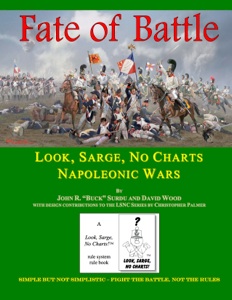
Fate of Battle:
Look, Sarge, No Charts Napoleonic Wars
Fate of Battle:
Look, Sarge, No Charts Napoleonic Wars




Join us on our yahoo groups list. Optional rules, photos and battle reports, and scenarios are posted periodically. Questions are answered by the authors.

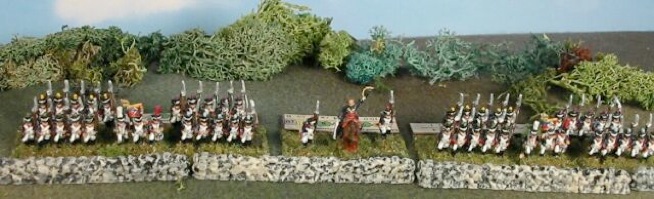
Buck’s first real wargaming love was the Napoleonic Wars. This will be his third set of published Napoleonic rules. Battles for Empire was designed for those Empire-sized games. Wellington Rules was designed for much smaller games, in which players would command brigades. Look, Sarge, No Charts: Napoleonic Wars is designed for larger games in which players command one or more divisions. Like all the Look, Sarge family of rules, this game moves.
This will be the most complex of the Look, Sarge rules family. We’ve worked hard to remain true to the spirt and feel of the series, but we’ve incorporated formations, skirmishing, and other period feel. You’ll get the paper, scissors, rock of infantry, cavalry, and artillery in columns, lines, and squares.
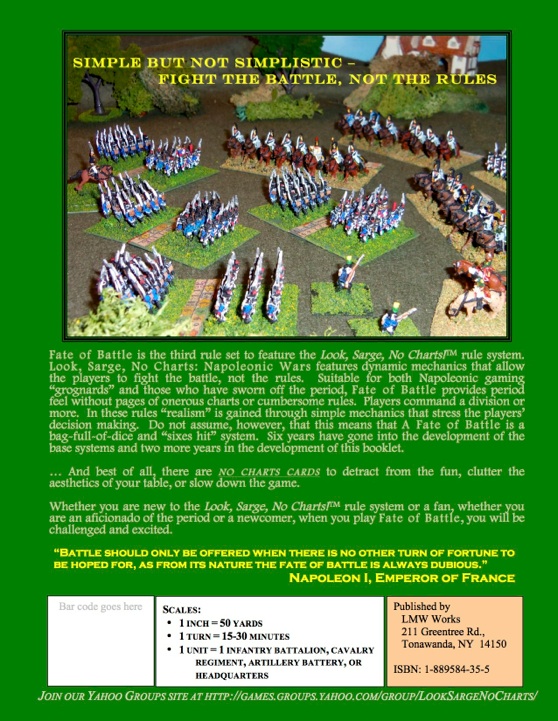
Many gamers are turned off by the Napoleonic Wars. Years of pedantic, plodding, overly complex rules and the angry rules lawyers those systems seem to attract have convinced many gamers we know that the Napoleonic Wars cannot be fun to game. Members of our gaming club who have sworn off the period enjoy these rules.

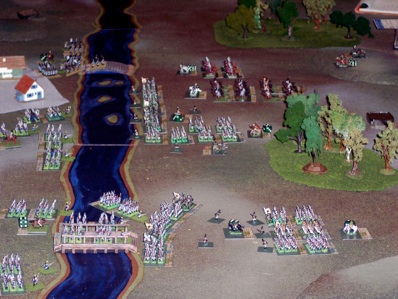
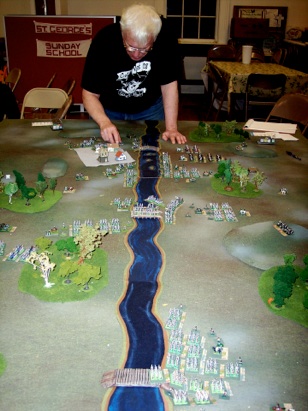
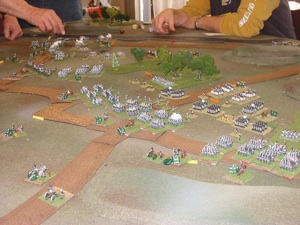
This is a picture from a recent play test game at a club gaming night. The scenario was a meeting engagement from Charles Grant’s Scenarios for All Ages. In this scenario, advanced guards from both the French and the Russians (in this case a corps from each) each were trying to capture the three bridges across the river. The side with two out of three bridges would be the winner.
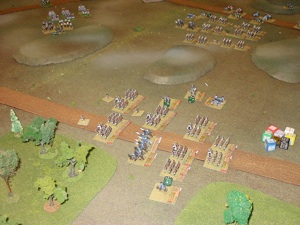
With Look, Sarge, No Charts, this is what a gaming table looks like during a game. These pictures were not prettied up for the photo. Green dice used for activation are placed near the brigade, division, and corps commanders. There are no large pink rectangles (chart cards) to spoil the aesthetics. (The rectangle you see in the picture on the left is a notebook someone was using to plan his next game.) To play the game you need to make some special dice from wooden cubes or blank dice. The bases have small labels on the backs of them with information on them. With the labels and the special dice, you have all the information you need to play the game, right where you need it. The systems are elegant and smooth.
For the Napoleonic version of LSNC we’ve added formations (column, line, and square) so that you get that paper-scissors-rock feel. We’ve also added a skirmish phase at the beginning of each turn. This provides an elegant mechanism to reflect the effect of skirmishers without gunking up the game.


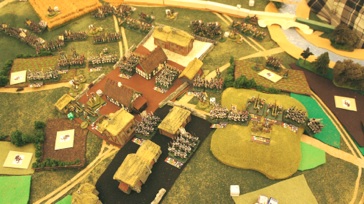
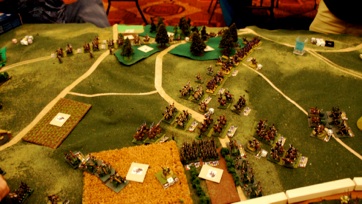
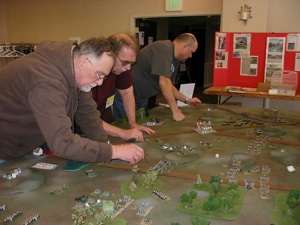
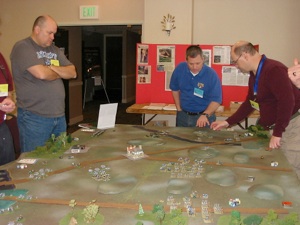
To the right are two pictures taken by Greg Robitaille at Southern Front. Greg played the rules at Historicon and asked to be a development play tester. He liked the rules enough to base his 15mm collection for the rules and to run three convention games using them about month before formal release of the rules.
Useful FREE Downloads
For those misguided souls who must have a chart, click here to download a unit roster for use with these rules.
Seriously, this roster will allow you to test drive the rules with your existing figure mounting. Enjoy.
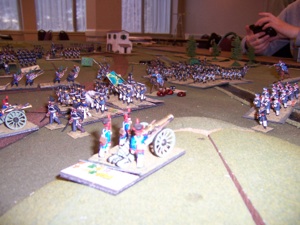
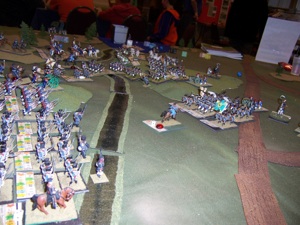
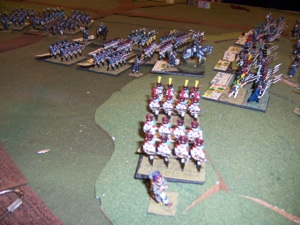
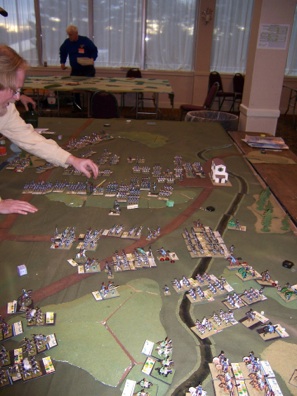
These are photos of Dave Wood’s Cold Wars 2013 game of the battle of Laon, 1814. Dave repurposed his old 25mm Minifigs by putting them on magnetic “sabot” bases and adding labels. You can see the game looked great and was a nice way to play the game without rebasing figures.
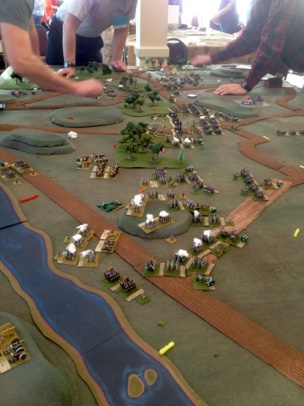
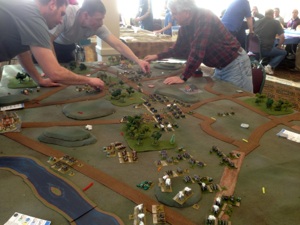
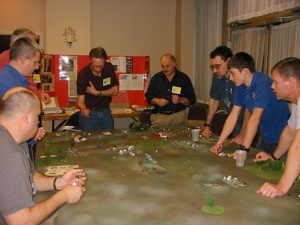
I ran three games at Cold Wars 2013 with 10mm Old Glory figures. All three were 1814 scenarios from a scenario book we are writing: Vouchamps, Montereau, and Craonne. The games went very well. Each of the battles was very tight until the end. At Vouchamps, the French captured two of the three roads along the Prussian line of retreat. At Montereau, the French only penetrated one of the three phase lines needed to achieve victory, so the Austrians eeked out a victory. At Craonne the French had initially achieved all their victory conditions; however, when their cavalry routed and a Russian brigade pushed through a gap in the French line, the Russians emerged victorious. The players quickly caught on to the rules and were running the game by themselves after a couple of turns. I saw a bunch of folks walking around the convention with copies of Fate of Battle under their arms.
Battle of Montereau, 1814
Battle of Montereau, 1814
Battle of Craonne, 1814
Battle of Vouchamps, 1814
Battle of Vouchamps, 1814
Battle of Vouchamps, 1814
Battle of Montereau, 1814
