I finally got past the writer’s block I’d been experiencing for weeks. I’ve now written the first couple of chapters. I had a large stack of 3×5 cards, but I struggled to get started.
What I did to break the block is to write one character’s story arc. One of the supporting characters in my Frank and Sylvia Mysteries is Ruby Sue. She has a crisis of faith in the fourth book. I wrote all the sections of the book regarding that crisis of faith. That pulled the finger out of the dike, and now I am moving forward.
I’m not sure I’d recommend this for everyone, but here is my technique. I had decided who the villain is, and his motivations. I had decided on how the mystery would unfold. I had a stack of 3×5 cards with notes. I knew how the main characters would solve the mystery, but I couldn’t get started.
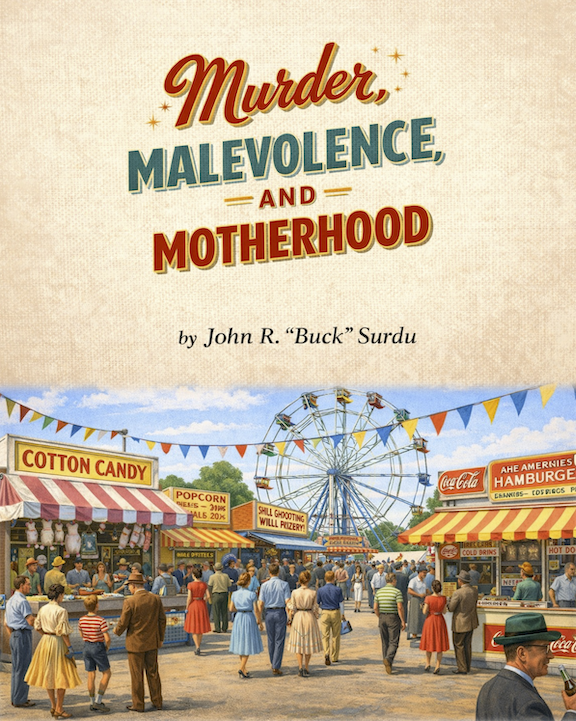
In the third book, I was in the same position. The Chicago crime boss whose rackets my main characters broke up in the first two books was going to trial and wanted to kill Frank and Sylvia so they couldn’t testify, so he put out an “open contract” to have them killed. So it was first come first paid. Several hitmen (and a few red herrings) came to town. But I couldn’t get started. So I wrote each hitman’s and red herring’s arc from beginning to end: how and when they came to town, how they tried to kill my protagonists, how they failed, etc. Soup to nuts. Then I wrote some other scenes, like when Sylvia and her friend Ruby Sue enter contests at the county fair. Finally, I started to weave these together: scene with hitman 1, scene with red herring 2, etc. In doing so, I had to rewrite many parts so the characters didn’t know things they shouldn’t have known yet. Writing the arcs began to fill the blank page.
In the fourth book, I knew that I wanted Ruby Sue to have a miscarriage, leading to a crisis of faith. I had much of that arc in my head, so I wrote it. It consists of about six sections that I’ll later interleave into the manuscript in the right places. It got me writing.
I also used Google Maps AI to help with an issue. I needed a place where five landmarks would be visible in 1955. They aren’t all visible from one place today, but Google Maps helped me find one in the book’s time period. In the fourth book, I now have a vantage point to see the five landmarks, which is key to Frank and Sylvia solving the mysteries.
I know the community is death on AI — and whether someone will falsely accuse my books of being written by AI keeps me up at night — but CoPilot is an excellent research assistant. I haven’t used AI to WRITE anything, but it is a good research assistant. It helped me understand counterfeiting in the 1950s. But it makes mistakes, and I caught one when it said that thermographic ink was used to prevent counterfeiting. I questioned that, and CoPilot admitted that thermographic ink wasn’t invented until the 1970s.
So, I guess, my general advice is to write what you know will be part of the story, even if you don’t have everything worked out yet. It fills the blank page. Some of it may be heavily edited or even thrown away later. I have an initial draft of 18,000 words. My other three books are in the 85,000-word range.
In the fourth book, Mrs. Crabtree, their teacher, is attacked. Frank and Sylvia, along with Nick and Ruby Sue, set out to find her attacker. The story will have some interesting twists along the way.
Meanwhile, I am continuing to tinker with the first and second books. The first has been professionally edited and picked up by a small traditional publisher. I plan to send the second book to the editor in December.