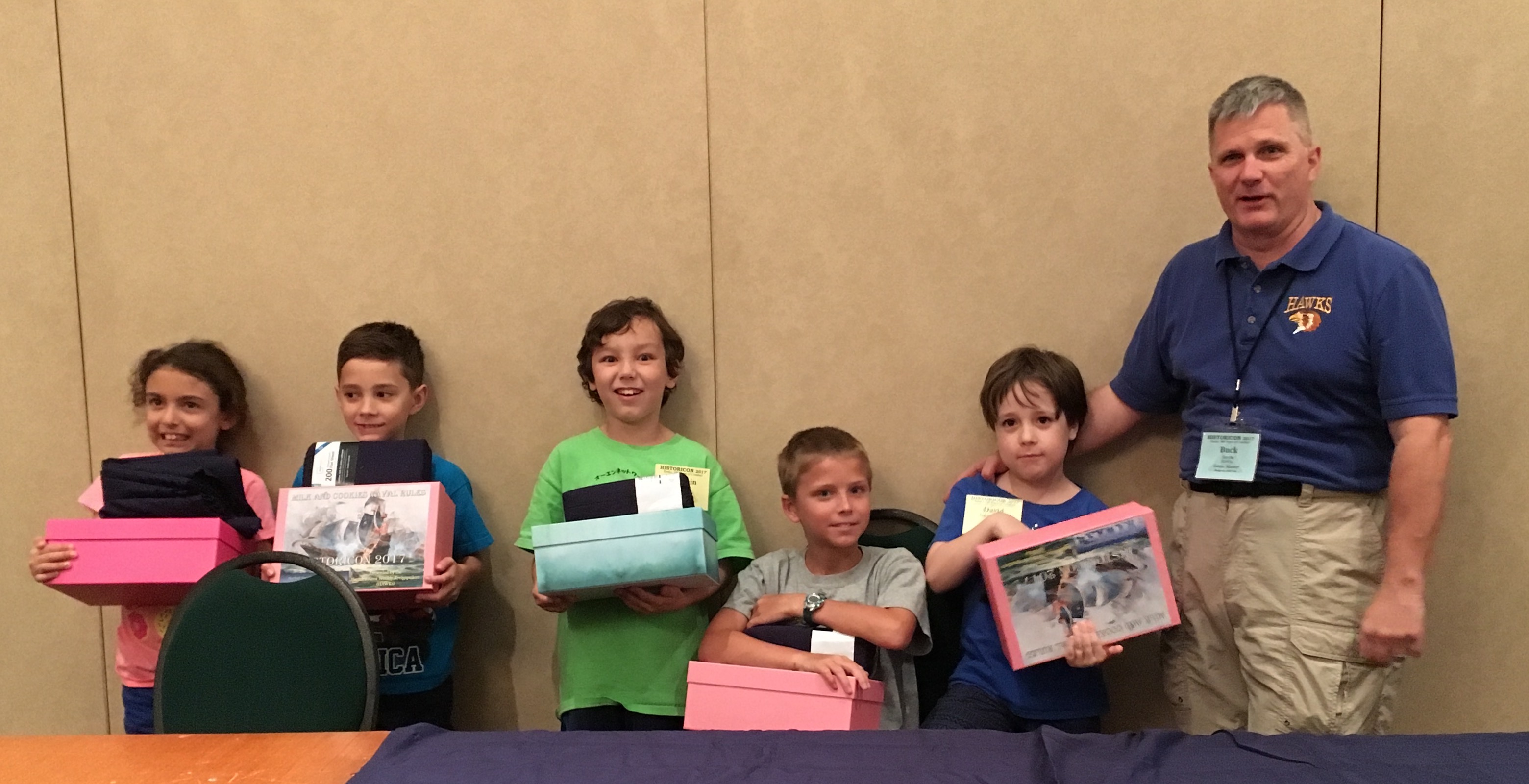
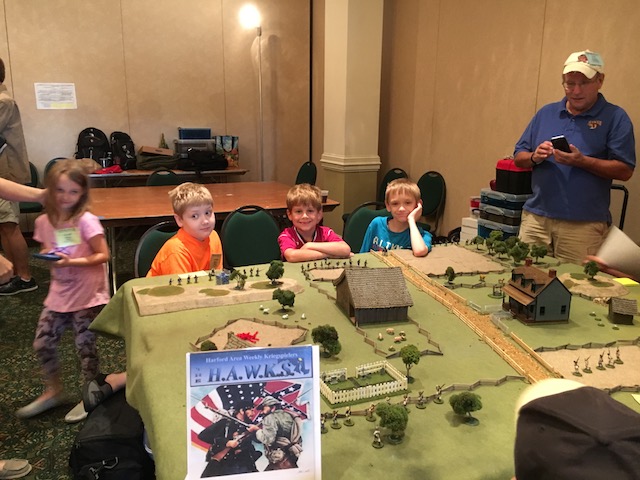
Geoff, Chris, Don, and Eric, HAWKs who won awards at Historicon 2017
We had four HAWKs win awards at Historicon 2017. Geoff won an award for this Lego pirate game for kids. Chris Johnson won an award for his American Civil War game for kids. Don won an award for his Battleground WWII game on our French village table. Eric won an award for his American Civil War game for kids.
There were several Combat Patrol(TM) games run at Historicon 2017.
French vs. Italians 1940
The first was a Thursday game run by Eric Schlegel set in southern France in 1940. It involved the Italians attacking the French. I only managed to get one poor picture of this game. You can see that the Italians had to advance across open ground to get to the French positions or slog through the woods. Despite some success on the Italian right flank, the game was judge a French victory.
Italians attack French positions in 1940.
The Bocage
I then ran two bocage games on Friday. Don and I set up the bocage table and then ran three games on it. I ran Combat Patrol(TM) in the morning and evening. In the afternoon Don used to table to run a game using “brand X” rules (Battleground WWII). In both of my scenarios the Germans were allowed hidden setup, and the Americans were tasked to clear the road. Unfortunately I was busy running the game and didn’t remember to take very many pictures. The ones I have don’t tell a coherent narrative, but you can at least see some eye candy.
An American halftrack has a bad day.Germans along a hedge row managed to knock out one or two American vehicles and withstand some infantry close assaults.
After the first scenario, every US vehicle had been knocked out, and the Germans had taken few casualties, so it was a decisive German victory.
Don's "brand X" game on the bocage table. This is the only long shot I took of the table that he and I used all day.American halftracks advancing during the second running of this scenario. The Pz II survived to the end of the game despite a jammed turret and repeated infantry close assaults. The Americans attacking the Pz II had no anti-tank weapons, so they were forced to try to throw grenades in the hatches, which is tricky business.A longer shot of the American advanceThe Sherman advances and the Pz. II drops back under close assault from American infantry.
The first running of this scenario was a decisive victory for the Germans. The Americans attacked across a wide front, weren’t very aggressive, and never were able to mass on a decisive point. The second instance was much closer. The Americans massed on the German right flank and enjoyed initial success. Then they got bogged down fighting for the farm house in the center of the table rather than bypassing it. The game was a marginal German victory.
Action around Pomme du Terre
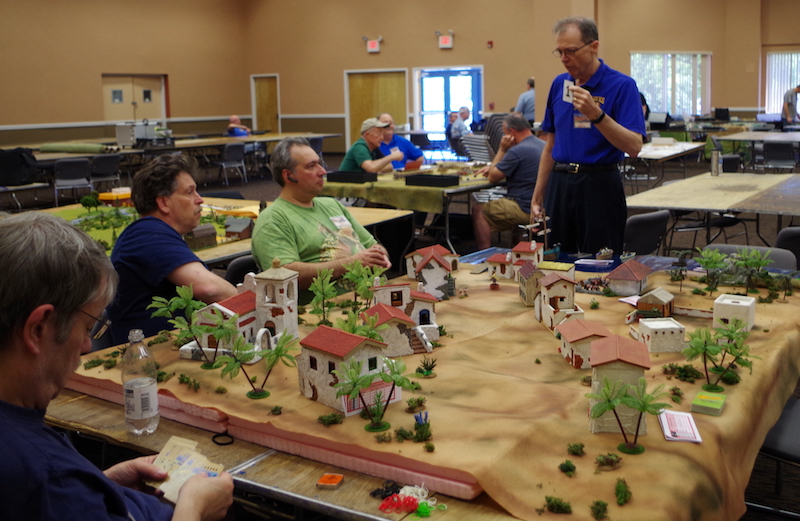
We then set up a French village, called Pomme du Terre, and ran four games on it to amortize the effort of laying out all the buildings. We ran three Combat Patrol(TM) games on the terrain and one with “brand X.”
The town of Pomme du Terre being set up for four scenarios. The town is almost exclusively Crescent Root buildings with a Sally 4th corner cafe and flagstone road, and Battlefield Terrain Concepts trees.Another view of the town
1918
Duncan used the town for Germans vs. Americans in 1918. I was running one of the bocage games while this game was going on, so I only snapped two quick pictures. Apparently the American platoon was pretty badly shot up trying to take the town from the Germans.
In these pictures you can see that Duncan uses flat disks from Fantasy Flight Games to mark morale checks. You can also see that Duncan printed unit cards with colored circles on them. These circles corresponded to colors on the figures’ bases and made it easier for players to figure out which troops were theirs when the fighting got close.
1940
Saturday morning I ran a German assault to capture Pomme du Terre from the French in 1940. The French were supported by an AT gun and three FT-17s, only one of which was equipped with a gun rather than a machine-gun. There Germans were supported by two Pz. II’s
German infantry advances to the outskirts of the town.Advancing German armored supportClose cooperation between German armor and infantry. In this picture you can see the command dice on the units that are used in the Double Random (TM) activation mechanic used in Combat Patrol (TM).
The Germans advanced steadily through the town but then got bogged down trying to clear the town square. Had they advanced around either flank, rather than right up the middle, they might have gotten to the French AT gun and cleared the road. The result was a French victory. All the players seemed to really enjoy themselves.
1944
My second game in Pomme du Terre was an American attack on the town. It was more of a meeting engagement as the Germans weren’t prepositioned in the town, but the onus remained with the attacker to clear the road. The Germans had a Panzergrenadier platoon with halftracks, two Pz. IV’s and a Marder. The Americans had an armored infantry platoon with halftracks, a Sherman, an M-10, and a Stuart. The Americans had a bazooka as well as several captured Panzerfausts. The forces were of roughly equal size.
The Sherman advances
The Germans lost a Pz IV early in the game from a shot from the M-10. The Marder was knocked out by a long-range bazooka shot. On the other side of the table, the Germans got THREE shots off at the Sherman but rolled very poorly and didn’t knock it out. They did damage the main gun, turning it into a mobile machine-gun platform. The Americans handled their vehicles aggressively. The combination of the Sherman, M-10, and Stuart kept the remaining German Pz. IV busy but didn’t knock it out by the time the game ended.
Marder knocked out by a long-range bazooka shot
Both the American and German infantry advanced into the town and got into close quarters combat in and around the town square. Despite heavy casualties, neither side managed to get a clear upper hand.
The Sturt and a halftrack advance through the town
A funny moment came when, after the left-flank Pz. IV was knocked out, an American halftrack dashed around the flank, dodging Panzerfaust shots, and circled behind the Germans. Big surprise for Herman as their infantry started taking fire from three directions.
Though the Germans didn’t knock out any US vehicles, they did knock out the 75mm gun not he Sherman. The objective was for the Americans to control the road through town. They didn’t manage to do this by the time the game ended, so we called it a marginal German victory.
We had one player who struggled to get his head around the card mechanics of Combat Patrol(TM) and another who wanted to argue the ratings of guns and armor for some of the vehicles, but otherwise the weekend was a big success. Many new players had a chance to try Combat Patrol(TM), and several went down and bought copies from the dealer hall — or at least said they did. I also had quite a few players who came back from either previous conventions or from previous games this weekend. Every one of my games was completely full, and I even added a couple of extra players who really wanted to try the rules.
As usual, the Harford Area Weekly Kriegspielsers ran several games focusing on kids at Historicon. Below is a quick rundown on some of them.
Navies for Kids Giveaway
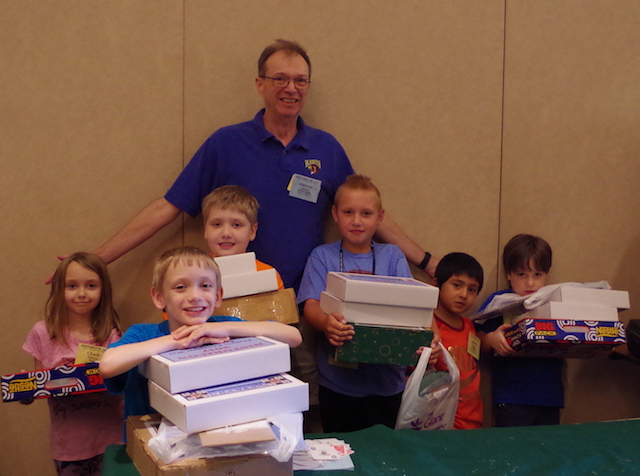
Buck Surdu ran a game in which a group of kids were given a box full of boats and other materials. They then chose sales for a stack of patterns and colored them. Then we helped them hot glue the sails to the masts. With a set of rules designed for this game, we ran a naval action pitting side A against side B. When the game was over, the kids took hope their two decorated boats, two more the assemble, rules, dice, measuring sticks, a sea cloth, and everything they would need to run the game at home for their buddies.
Some of the kids inspecting their suppliesDecorating sailsGetting help to hot glue the sails to their mastsWaiting patientlyThe game in full swingThe kids and their loot
Armies for Kids Giveaway
We worked all year through a series of club painting days and other events to build six complete sets of armies (one French and one Prussian) for a 15mm Franco-Prussian War giveaway. As in previous years, the kids played the game and then each went home with a French Army, a Prussian Army, terrain, dice, tape measures, and a ground cloth.
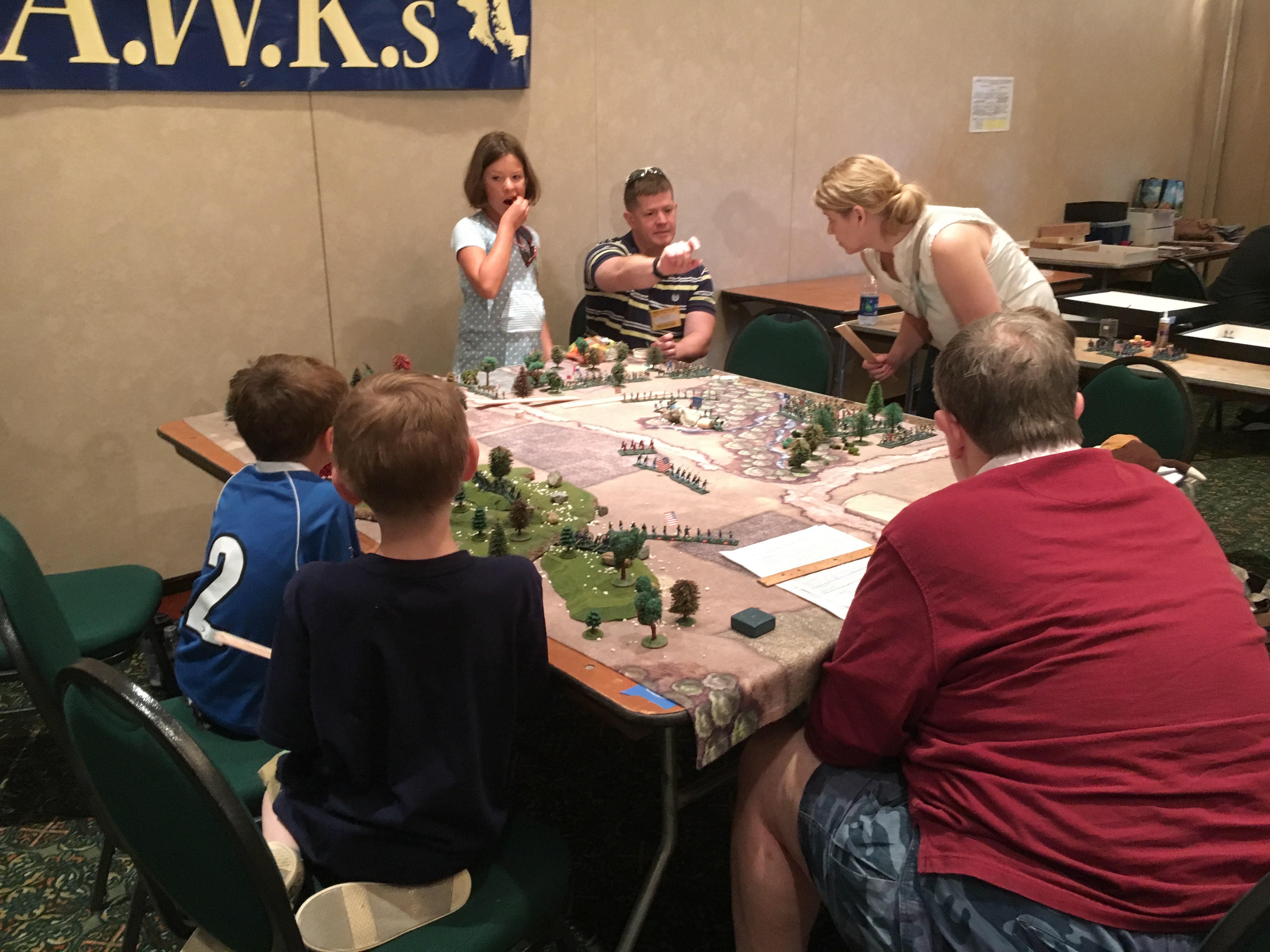
Some of the kids playing the FPW gameAnother view of the game in progressDuncan puts a set of figures back together after the game.Putting sets together to hand out to the kids.
Santa Duncan hands out lootDuncan and the six lucky kids
Chris Johnson’s Award-Winning ACW Kids’ Game
Chris was presented an award from the convention staff for this kids’ game.
Eric Schlegel’s Award-Winning ACW Kid’s Game
Duncan Adams’ Lionheart Game for Kids
Geoff Graff’s Award-Winning Lego Pirate Game for Kids
This has been a perennial favorite in the HAWKs rooms for many years. Geoff never fails to keep the kids entertained and engaged!
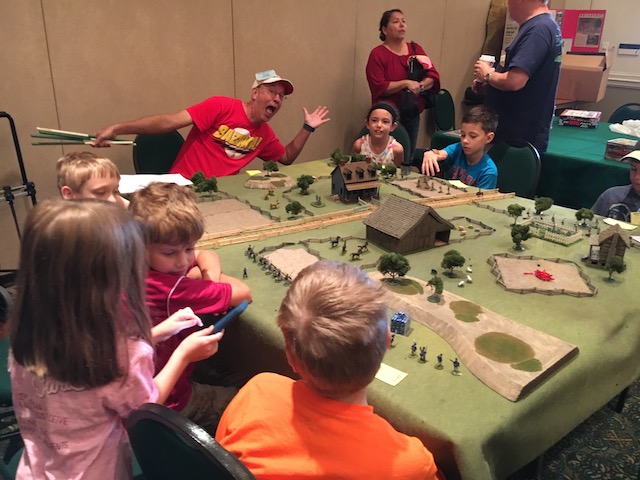
The game gets under way.You can tell that Geoff enjoys these games as much as the kidsA boat full of Lego pirates. The ship comes apart to reveal the lower decks.
The answer to my question, "Who had fun?"A happy Geoff and some happy kids -- or maybe that's redundant...
Chris Abbey at Sally 4th just published a very nice battle report on a Sea Lion game he ran with Combat Patrol from the Bolt Action scenario book. See the details here.
I completed a new demonstration video for Combat Patrol(TM) over the weekend. This one focuses on how to resolve grenades and high explosive attacks. It is visible on both the Combat Patrol(TM) Web page and on the Combat Patrol(TM) Facebook page.
I have begun to format the cards for the Japanese South Pacific supplement to Combat Patrol(TM): World War II. The Action Deck is largely the same as the basic rules. The difference will be in the morale section. For the Japanese cards, the morale results are more unit type results and fewer individual results. The graphics look more tropical as well.
The South Pacific set will include three Action Decks. For those who don’t want to buy the South Pacific set of Acton Decks, they can look up the serial number on the bottom of a card and index the result in a table in the South Pacific supplement. Other than the cards, the South Pacific supplement will be a free download, like all the other supplements.
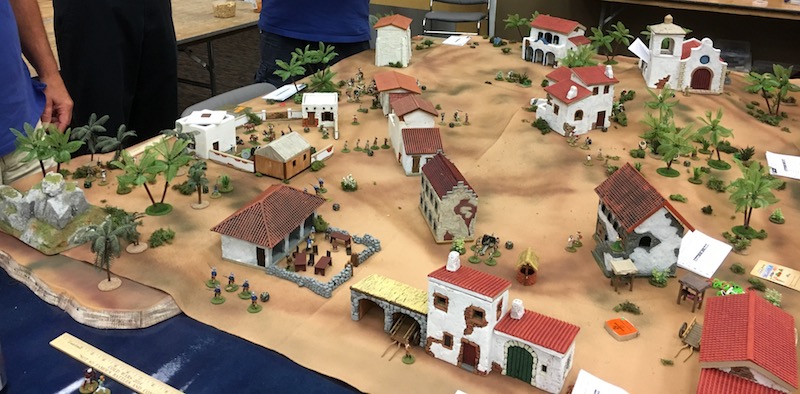
Battle commences in a Caribbean port town during the War of 1812
Several HAWKs (Duncan, Eric, Chris J., Zeb, and I) went to NJ Con (Fire in the East) this weekend to run and play some games. To minimize the amount of terrain we needed to carry up there, we ran a series of scenarios in different historical periods on a the same terrain, with minor changes between games.
War of 1812
Duncan prepares to run with War of 1812 game using the Napoleonic supplement to Combat Patrol.
The first was a War of 1812 game using the free Napoleonic supplement to Combat Patrol(TM). The scenario involved an American force landing in a small, British-held, port town in the Caribbean.
A British unit advances from a small building
The Americans landed in small boats and then advanced inland to destroy the British supplies. While the Americans got to the British supply room and started it on fire a couple of times, the British were able to put it out.
The Americans got to this house and set up before I got there, even though I started closer to it. I charged up the stairs to try to take back the building -- but that didn't work out too well.
The game was a lot of fun, and I think the scenario was pretty balanced, but in the end, the Americans left the table without successfully destroying the supplies.
British defending the supplies, which were stored in the wooden building with canvas roof.American sailors on the beach.
Moros in the Philippines
Our second game on this table was a Moro assault on an American-defended village in the Philippines. For this game, I left the terrain exactly as we had for the War of 1812 game. Where the Americans attacked British from the beach, the Moros attacked from the opposite edge of the table, swarming out of the jungle.
The Moro game is about to begin!
The Moros had to attack out of the jungle, burn the same supply hut, and capture livestock. In the lower right of the picture above, you can see that the Americans had a small field gun, but the crew was asleep in one of the buildings when the attack began. They had to rush to the gun before they could fire it. The gun was able to knock out the Moro gun by the end of the game.
Moros swarmed over the village.
The American force consisted of two squads of infantry, a squad of Moro Constabulary, and a squad of Filipinos. The Moros had 12 teams of infantry and a black-powder improvised gun. The American players felt like the Moros were swarming over them, and there were a number of nail biting moments. While Eric’s Moros got to the supply hut, they were unsuccessful in lighting the supplies on fire.
Pass of the North Moros advance out of the jungle.
The Moros had few rifles, but they were really good in hand-to-hand combat, so the Moro players spent a lot of time trying to close with the Americans. I also gave the Moros and extra +1 in hand-to-hand when they charged with spears. The Moros generally did well in hand-to-hand combat, but there were some upside down moments when two Moros ganged up on a single American but lost the combat anyway.
More Moros?! How many are there?
Wild West
The third game was a wild west shoot-em-up using Zeb Cook’s recently-released Wild West supplement.
Eric and Jeff preparing to begin the carnage.
For this game we added a few more buildings, replaced the palm trees with cacti, and changed up the “set dressings.” I think the town looked convincingly southwestern.
Howard Whitehouse preparing to enter the dynamite, coal oil, and whiskey storage shed!
In Zeb’s town there was apparently a desperado convention being held. The figures standing on the poker chips had a price on their head equal to the value of the chip. There were four teams of bounty hunters competing to collect the most bounties. In addition, each of us had a price on our head, so there was a lot of incentive to shoot each other as well. Wild and wooly mayhem ensured.
Advancing into the Cantina to gun down an outlaw -- and perhaps stop for a whiskey.
I think in these pictures you can see that changing up a few items made the town convincing for different historical periods.
No Western town is complete without a gallows.
Richard Sharpe with Blood and Swash
In addition to our three Combat Patrol(TM) games, Eric ran a Sharpe in the Peninsula game, using Blood and Swash. A memorable moment came when Harper fired his volley gun and killed both Hakeswell and Sharpe.
You can see from these pictures that swapping out the cacti with some deciduous and palm trees and removing much of the wild west set dressing made the town look like the Peninsula.
There will be many Combat Patrol(TM): WWII games at Historicon. Make sure you sign up for one of these games and don’t miss the excitement of playing these terrific skirmish rules.
T-184 Late to the Party Theme
World War II; 3 PM; Length: 4 hrs; Hosted by: Eric Schlegel; Scale: 20mm; Rules: Combat Patrol; No. of Players: 7.
12 June 1940. A month after the German invasion of France, the Italians finally declared war and began sending troops through the mountain passes. On the 12th an advance force supported by light armor encountered a French border force near the village of au Coeur des Tanbres. Players under 13 welcome with a playing adult.
F-186 Slogging Through the Bocage
World War II; 9 AM; Length: 3 hrs; Hosted by: Buck Surdu; Scale: 28mm; Rules: Combat Patrol(TM): World War II; No. of Players: 6.
As part of a battalion attack, a platoon of US infantry slogs its way through rows of bocage and fields. Their mission: seize the farmhouse in the distance and open up the road for the advance of the tanks. What is behind the next hedge? What is that diesel sound? Is it a tank? Could it be one of ours or one of theirs? Combat Patrol(TM) features an intuitive and streamlined, card-based mechanic for resolving combat. Fight the game, not the rules.
F-305 Slogging Through the Bocage, part 2 Theme
World War II; 7 PM; Length: 3 hrs; Hosted by: Buck Surdu; Scale: 28mm; Rules: Combat Patrol(TM): World War II; No. of Players: 6.
As part of a battalion attack, a platoon of US infantry slogs its way through rows of bocage and fields. Their mission: seize the farmhouse in the distance and open up the road for the advance of the tanks. What is behind the next hedge? What is that diesel sound? Is it a tank? Could it be one of ours or one of theirs? Combat Patrol(TM) features an intuitive and streamlined, card-based mechanic for resolving combat. Fight the game, not the rules.
F-169 First Battle of Pomme du Terre – 1918
World War I; 7 PM; Length: 4 hrs; Hosted by: Duncan Adams; Scale: 25mm; Rules: Combat Patrol; No. of Players: 6.
In the waning days of the Great War retreating German troops fight a rear-guard action in a French village against relentless Americans pursuit.
S-306 Action at Pomme du Terre, 1940
World War II; 9 AM; Length: 3 hrs; Hosted by: Buck Surdu; Scale: 28mm; Rules: Combat Patrol(TM): World War II; No. of Players: 6.
The Nazi juggernaut has pushed across the Meuse River. A platoon of French infantry is cut off in the village of Pomme du Terre. Their last orders before the radio cut out were to hold the village and its important crossroad as long as possible. Lightly armed and under strength, the platoon begins to prepare its defenses when they hear the unmistakable sound of diesel engines in the distance. It won’t be long now! Combat Patrol(TM) features an intuitive and streamlined, card-based mechanic for resolving combat. Fight the game, not the rules.
S-307 Action at Pomme du Terre, 1944
World War II; 1 PM; Length: 3 hrs; Hosted by: Buck Surdu; Scale: 28mm; Rules: Combat Patrol(TM): World War II; No. of Players: 6.
The Allies are advancing across central France. An armored infantry platoon from the Big Red One is ordered to seize the village of Pomme du Terre and its important road junction to prepare the way for a lightning advance by their battalion the next morning. The German Lieutenant has been ordered to hold the road junction as long as possible, and he has been reinforced with assets from his parent Kampfgruppe. Will the Americans dig them out of the town or fail in the attempt. Combat Patrol(TM) features an intuitive and streamlined, card-based mechanic for resolving combat. Fight the game, not the rules.
NJ Con will be held on 9-10 June in New Jersey. A number of the HAWKs are going to head up to run a few games. Among the games we are taking up there are three Combat Patrol(TM) games.
Zeb Cook is running a cowboy game using his under-development Wild West variant of Combat Patrol(TM): World War II. Various factions battle it out in a wild west town.
Duncan Adams will run a War of 1812 game using his recently released black powder era supplement for Combat Patrol(TM). This scenario is set in a small Caribbean coastal village. The Americans land in the village to push out the British.
I will be running a US vs. Moros game, set in a coastal village in the Philippines.
Come and experience the streamlined mechanics of Combat Patrol. Cards are used to resolve combat, not just manage activation. A card draw takes the place of calculating a bunch of modifiers, rolling some dice, and then looking up a result on a table. The result is that you can fight the game, not the rules. Check out the rules’ Web page for demonstration videos, free downloads, and other information.
Both Tom’s and Sam’s Spring breaks were the same week this year, so we took a family vacation to southern Florida to see the Everglades and the Keys. We began our trip with half a day in the “Little Havana” portion of Miami, where we indulged in some terrific food. We also purchased some Cuban sandwiches to take with us to have later for dinner. During the walking tour the guide talked a lot about the Cuban community and the Bay of Pigs invasion. We also passed a relatively famous park where the old timers play dominoes.
After leaving Miami, we headed for Everglades National Park.
The Everglades were worth seeing, but frankly, they were the least impressive of all the national parks we have visited. There is not much variation from one stopping point to the next. After you’ve seen a few gators and birds, not much changes. Again, it was worth seeing, but I think we’ve checked that box.
From the Everglades we headed down into the Keys, stopping for the night on Key Largo, staying as we usually do at a mom and pop motel.
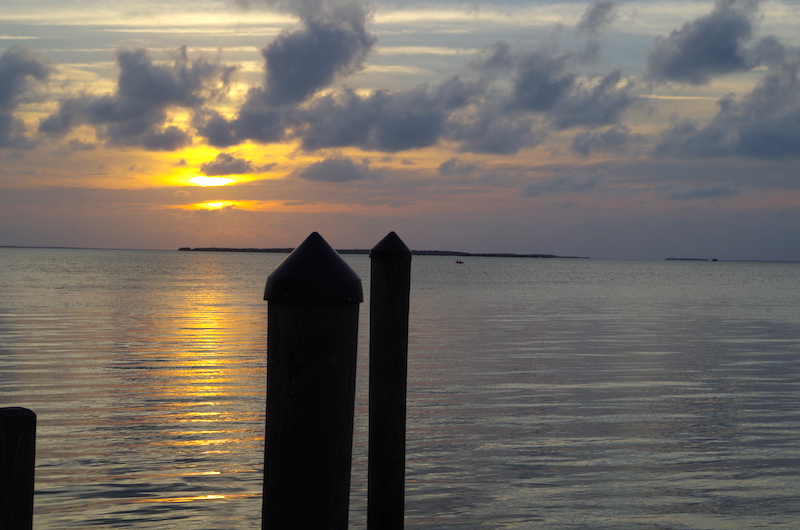
The Seafarer is on the “bay side” of the keys, pointing north and west toward the coast of Florida. From here we could see a terrific sunset.
We also enjoyed our Cuban sandwiches on the deck next to our room. The Seafarer was low on ambiance on the outside of the rooms, but the insides were very nice, and they provided a nice continental breakfast that included egg frittatas,
Cuban sandwiches made by Cubans in Little Havana. Oh, how cultural of us!
The next morning we had planned to take a boat out the reef and snorkel for an hour or so. The surf was too rough, with three-foot waves, so they weren’t taking folks out to the reefs who weren’t very experienced snorkels. It wouldn’t have been much fun under those conditions, so instead we took a glass-bottom boat tour out to the reef.
While waiting for our glass-bottom boat tour, we enjoyed the small aquarium at the state park.
After about a 40 minute boat ride out to the reef, the boat slowed and loitered over the reef for about an hour while a guide pointed out different fish and coral.
The number of fish wasn’t as high as I had expected, so after about 30 minutes, I had seen what I needed to see. If the tour had been planned for just 30 minutes, however, it might have seen too short for the amount of money we paid. This was definitely worth doing, but I think it would have been better in calmer weather.
From Key Largo we headed to Marathon Key. We had a terrific dinner at a local (but sort of expensive) seafood restaurant. The local fish is yellow tail, and I had a lot of it during the trip. It is a nice white fish that doesn’t smell or taste to seaweedy.
We had an upstairs room with a nice view of sunrise, since we were on the “ocean side” of the Keys.
Sunrise at Marathon Key
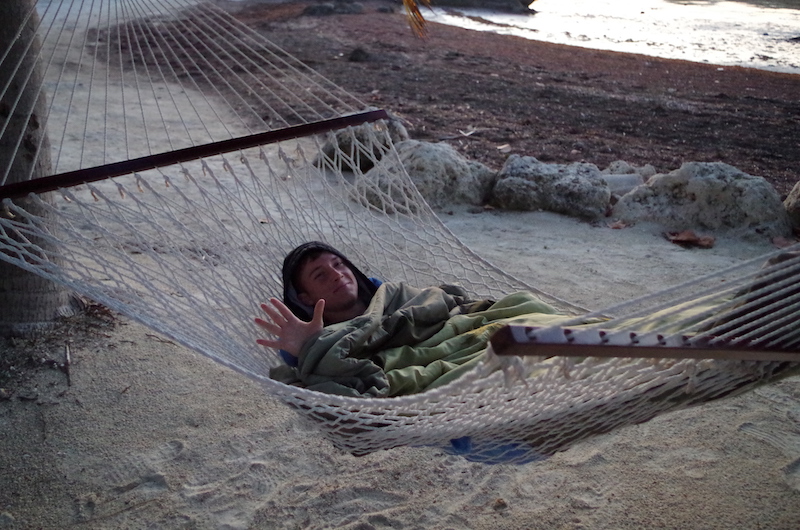
Our second night at this hotel, Tom decided he wanted to sleep outside in a hammock. It got a little chilly, but he said it was very nice.
Morning on the beach...
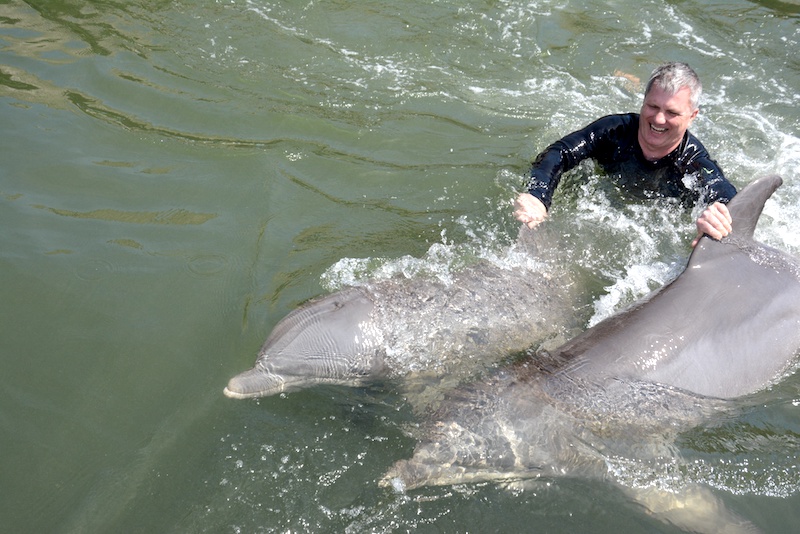
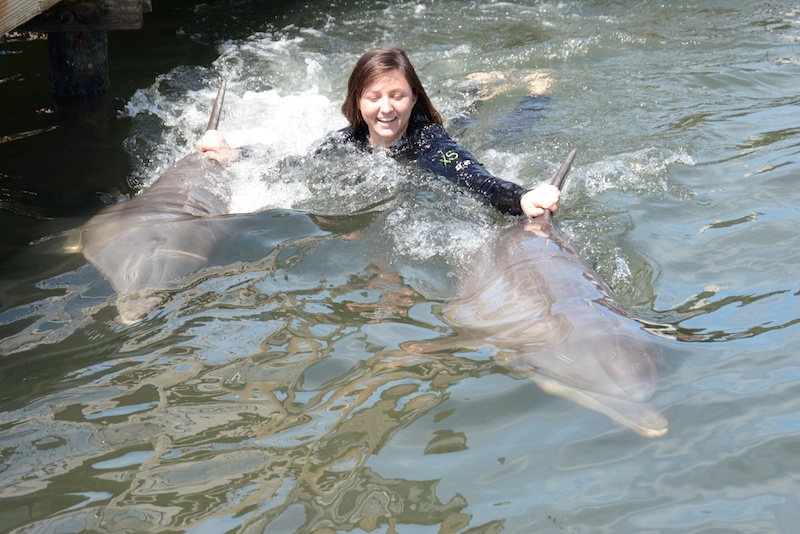
Marathon Key turned out to be the highlight of our vacation. We visited the Dolphin Research center and paid an insane amount of money to swim with the dolphins. As the weather was a little chilly, we rented some wet suits from a local dive shop.
Suiting up...
Each of us had a chance to get pulled around the tank by a pair of dolphins.
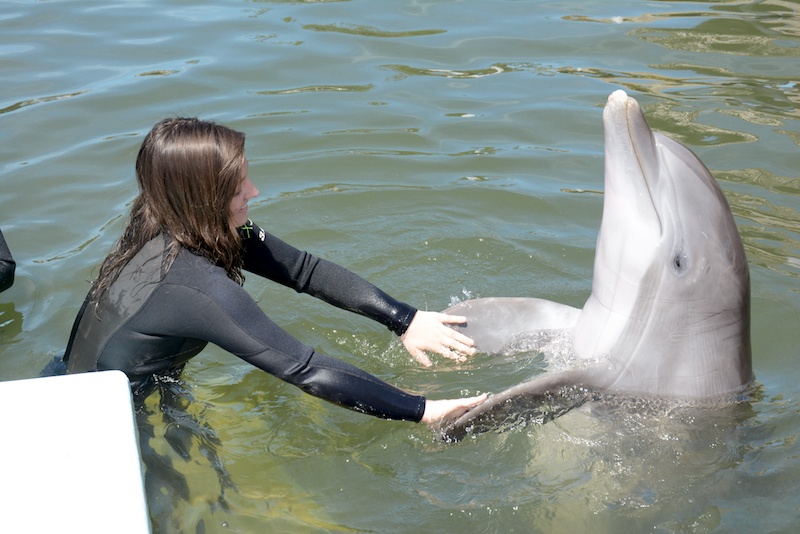
Then we each had a chance to perform some other tricks with dolphins, such as…
… shaking hands…
… and getting a smooch.
In this picture we’re not telling them to wait a minute or count to one. We are preparing to tell them to swim fast across the pool. They were so fast that if you blinked you might actually miss them swimming across the tank.
From Marathon Key we headed to Key West. Along the way we saw an electrician working on some power lines from a helicopter.
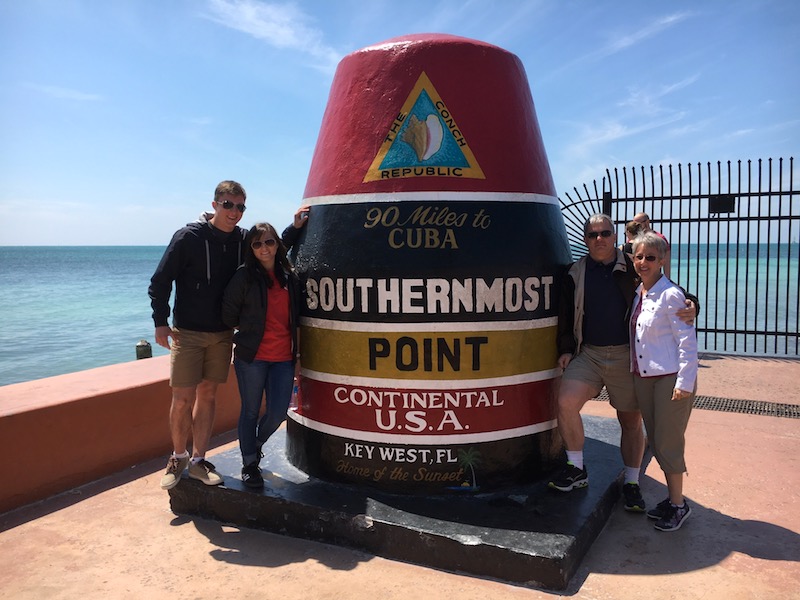
Here we stood on the southern most part of the continental US and found the beginning of highway one, which runs up the coast to Maine.
Frankly, Key West didn’t do much for any of us. The place seems to really be about nightlife, partying, and drunk people behaving badly. We had some very good food, and had a good time, but it is a place I am not in a hurry to visit again.
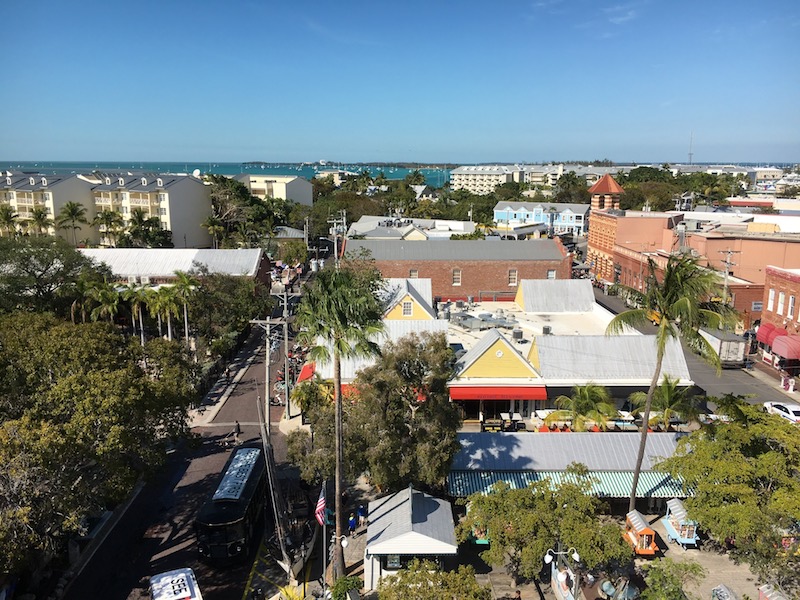
A view of Key West from the tower at the shipwreck museum.
We visited Ernest Hemingway’s house on Key West, which was interesting. We also saw the 50+ cats, a large percentage of which have six toes.
It wouldn’t be a vacation without miniature golf. There is only one miniature golf course on the Keys. Being the only one, it could have been bad and still been crowded, but it was one of the better courses we’ve played. So we played it again on our way back to the mainland for our flight home. The first time we played, three of us had 49s and one had a 50. The second time the spread was about four points between first and last place. The miniature golf has become quite fun as everyone has come close in skill.