Today I finished the figures I will be using for the demonstration / participation games at Cold Wars next weekend. Several members of the HAWKs are also painting figures to be ready. You really need to come and try these rules and see these figures at Cold Wars.
A mass of Winkies
Here is a brigade of five regiments of Winkie infantry. The brigade commander is riding a Zilk.
Another view of the mass of Winkies.
Winkies are cheap troops, because they have no firearms. But they do well in melee, and there are a lot of them.
Another view.And one more view.These are the Winkies I completed today.And a closer view.
I also recently finished three regiments of Quadlings.
Southern Province QuadlingsAnother view.Central Province QuadlingsAnother view.Northern Province Quadlings.A closer view.Lesser Pumpkinheads ready for action.
I woke at 0230 this morning, and I started thinking about work and couldn’t get back to sleep. So, I went to the painting lair and continued work on the Wars of Ozz figures I need to have done for Cold Wars demonstration games.
Quadlings from the Northern Province.
Quadling land is made of three provinces: North, Central, and South. These are big farm boys. The Northern Province Quadlings have a roughly British Napoleonic look about them. The regiment picture above is nearly complete. I need to paint the officer’s sash (probably green) and base and flock them. Due to the race to get a LOT of units painted for Cold Wars, decoration of the bases will probably not be done in time.
Central Province Quadlings.
The Quadlings from the Central Province have a roughly French Napoleonic look about them. These are getting close. I need to paint the three colors on the muskets (black, brass, and silver) some of the lace, the blanket rolls, and the bases.
Southern Province Quadlings.
The Quadlings from the Southern Province are meant to be roughly American War of Independence looking in their homespun brown coats. I have to paint the rifles and red stripe down the trousers. I also need to affix the flags to all the units.
For all three regiments, I need to paint the drums and attach them to the drummers. If I can stay up long enough this evening, I should finish the Quadlings and only have two regiments of Winkies left to paint by Sunday evening.
I have been painting at a feverish pace to get all the pre-production figures ready for FOUR demonstration games at Cold Wars in two weeks. Below you can see the work in progress pictures of many of the units. I don’t think any of these units have been previewed before, so enjoy this first look. (The figures are nicer than perhaps my paint job conveys, but these will give you an idea what will be coming soon.)
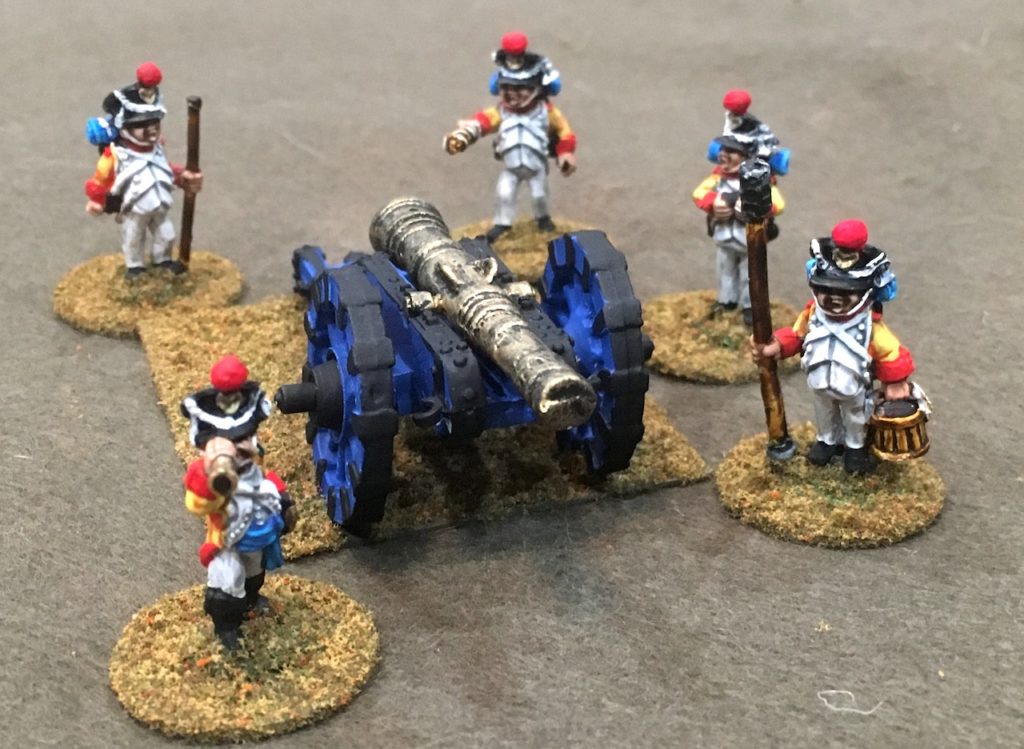
A view of the Munchkin light cavalry regiment. I have not decorated the bases or put on the flags yet in these pictures.Another view of the Munchkin light cavalry.A view from a different angle. All Munchkin cavalry is equipped with carbines.A view of Munchkin heavy calvary. These are also armed with carbines.Another view.Munchkin heavy artillery. Note the bright colors of the artillery carriages. A result of the “madness bombs” that caused society to disintegrate is that the survivors have a penchant for bright colors. Munchkin light artillery.Gillikin heavy artillery.Gillikin light artillery.
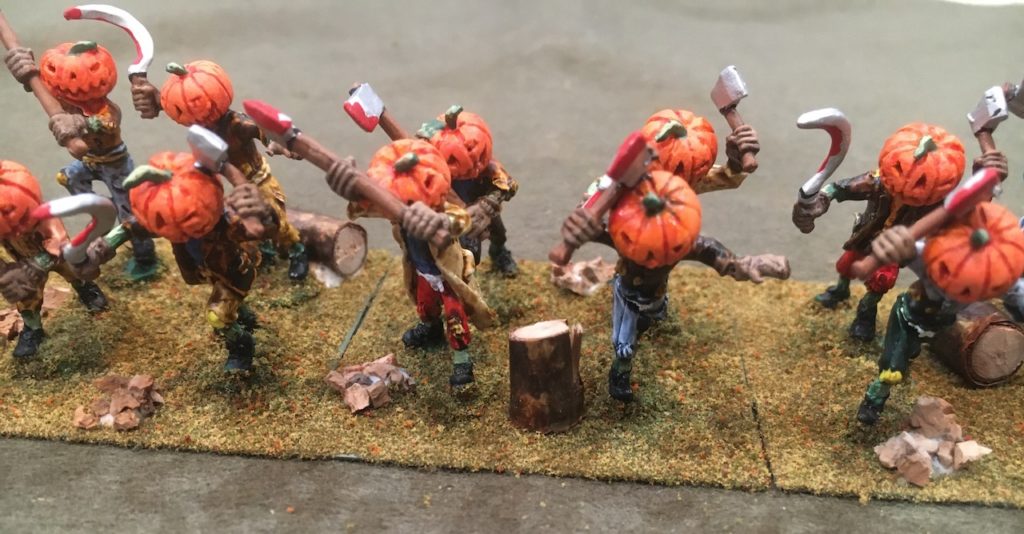
In addition to the four major nationalities (Munchkins, Quadlings, Gillikins, and Winkies), there are a number of other forces that can be used as “allies” or mercenaries when players create their armies. Below are pictures of one of those allies, the lesser pumpkin heads.
A view of lesser pumpkin heads.Another view.A third view.A long shot of a lesser pumpkin head regiment.
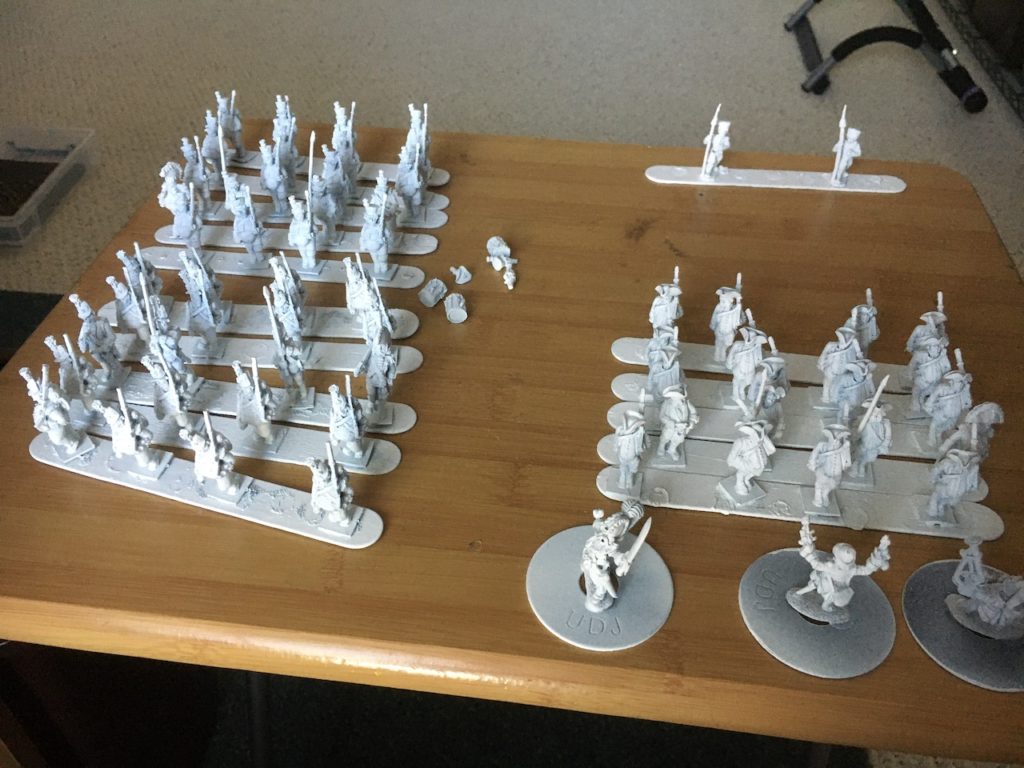
I have three regiments of Quadlings to try to finish by Cold Wars. Here they are on the table ready for a coat of apothecary white.
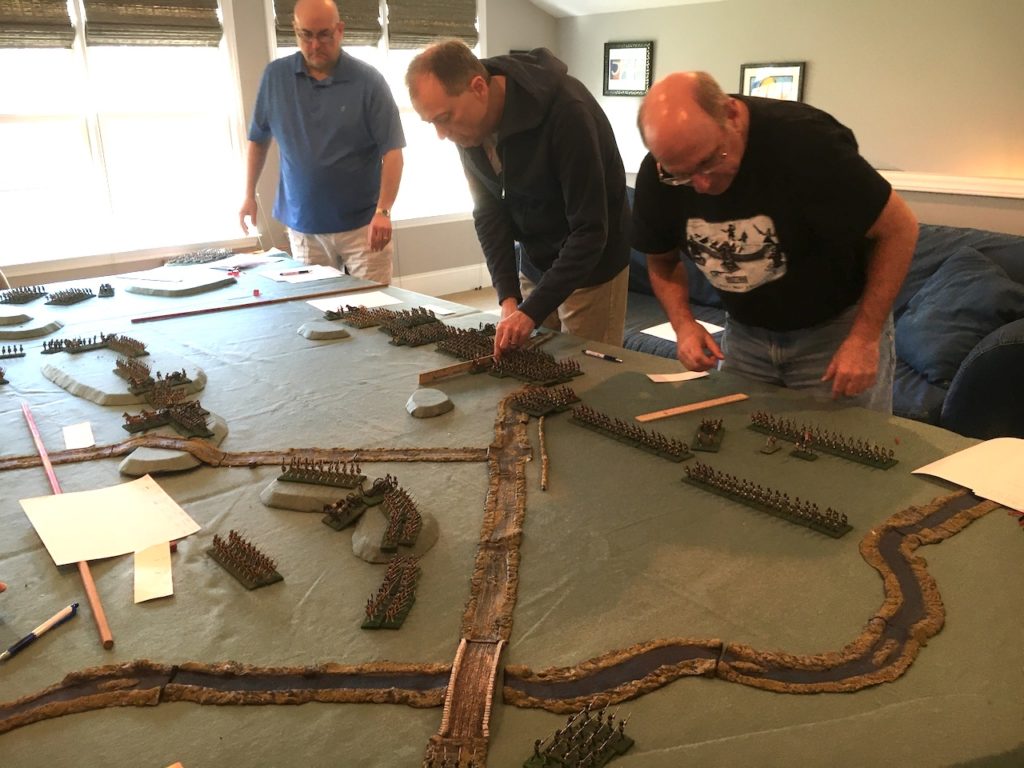
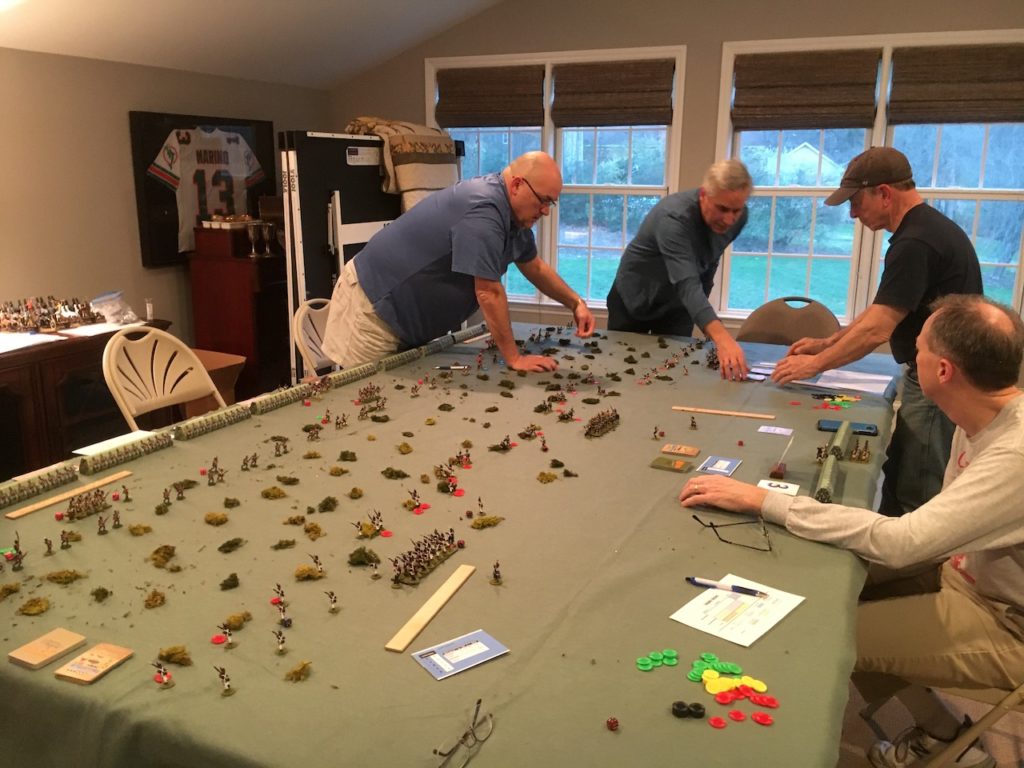
I was up in Maryland last weekend and had a chance to rejoin the HAWKs for club night. Along with Chris Palmer, Greg Priebe, Duncan Adams and Zeb Cook, we staged a rather large play test of Wars of Ozz. The rules are coming along. Each play test uncovers some minor issue that needs to be addressed or more clearly described in the draft rules, but the basic mechanics are working pretty well.
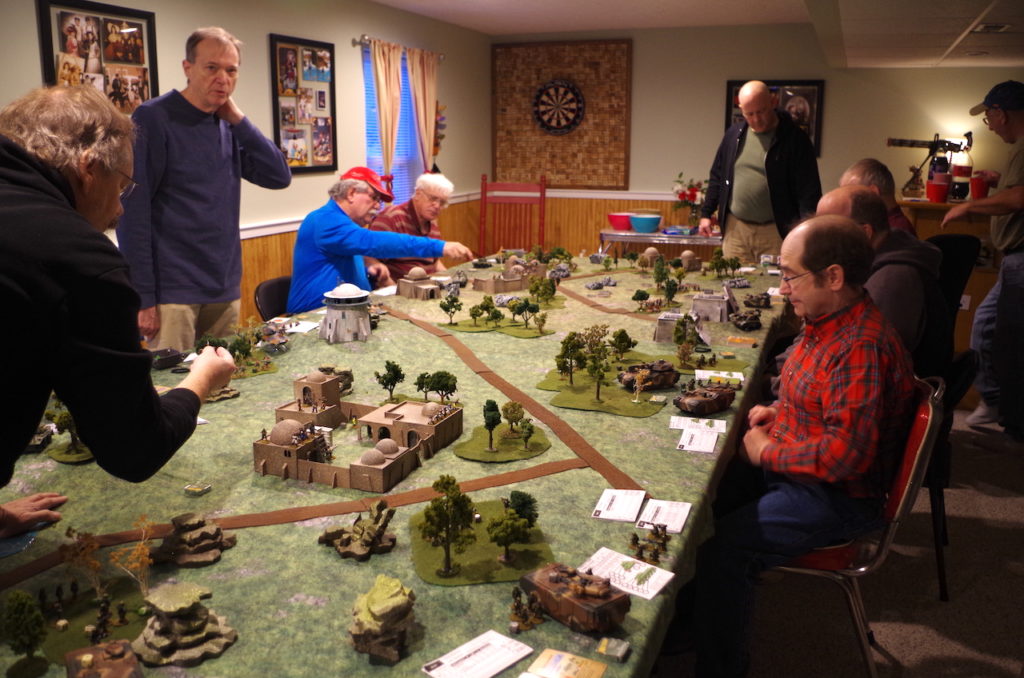
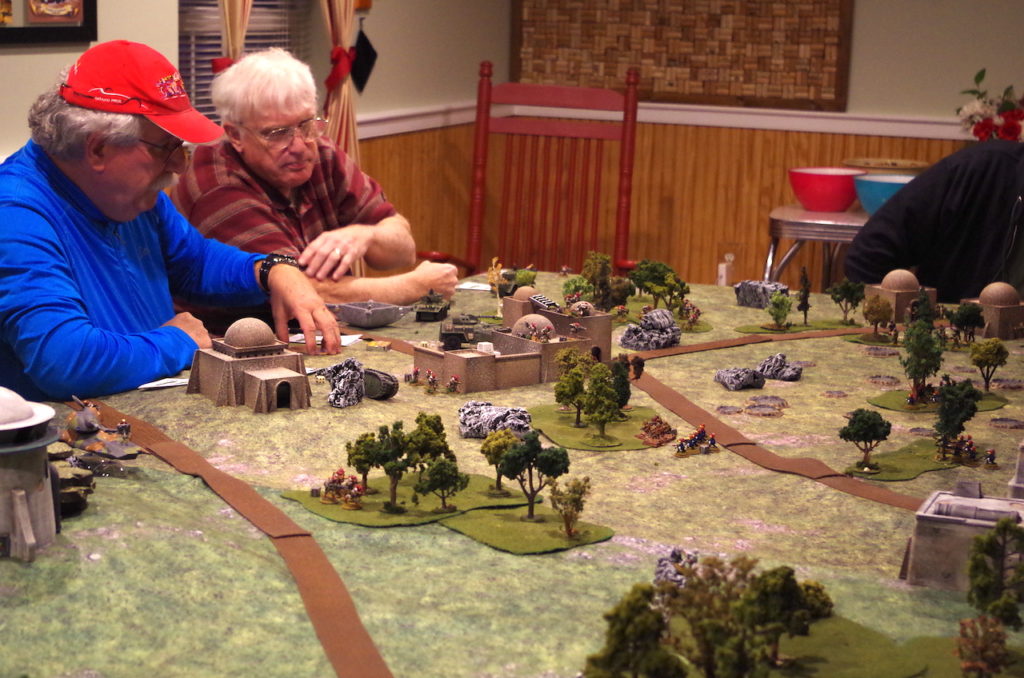
Zeb’s Winkies and Great Winged Apes attack Chris’ Munchkins and Great Pumpkin Heads while Greg holds the Munchkin center.Duncan’s Quadling infantry and cavalry advance up the center to seize the Munchkin village. Duncan’s die rolling was habitually poor, so his forces advanced pretty slowly.In the foreground you can see some Munchkins defending the field and town while Eric’s and Kevin’s Winkies (played with ersatz figures) advance.A long shot of the table about 1/3 into the game.
We have Wars of Ozz official figures of Munchkins, some Winkies, and some of the other allies, but as we continue to play test the rules, we use ersatz figures as stand ins.
A close up shot of Zoraster’s guard defending a hedged field.A view of two Winkie regiments early in the game.All smiles before the carnage began.The bad guys prepare to attack.
Each year around the last weekend in January (usually Super Bowl weekend) a bunch of us get together to game our eyes out all weekend. Some are my high school gaming buddies, some are HAWKs. It is at my buddy JJ’s house outside Charlotte, NC, so we refer to the weekend as JJ Con. There were six of us this year as a few of the regulars were unable to attend.
I am in the middle of a move from Maryland to Florida. I had a car full of electronics and breakables, and Charlotte was a nice half way point. Of course a weekend of sleep deprivation made the second half of the drive from North Carolina to Florida less fun.
Friday we played a Combat Patrol(TM) France 1940 game with a scenario from one of the Skirmish Campaigns books. It was a lot of fun. Several of the attendees of JJ Con only game this one time a year, so we tend to stick with simple-to-learn rules and try to use the same rules each year to reduce the re-learning curve. Mark and Nick quickly recalled the Combat Patrol rules and were good-to-go after a turn or two. The French defenders won. We also played Eric’s fun cowboy game using Blood and Swash. That evening we played Roman Circus chariot racing and a “board game,” called Captain Sonar. Both were much fun.
Column, Line, Square
Saturday turned out to be Napoleonic Day. When we were in high school in Michigan, one of the adults we played with was Nick, who now lives in South Carolina and attends JJ Con each year. He played a lot of Column, Line, Square in the old days. Since moving to South Carolina his French, Russian, and Austrian armies have been packed away in boxes. I have been encouraging him for several years to break them out and put them on the table. This year he did! CLS has a great old-school feel. You do multiplication. The rules were written on a typewriter. And there were these wonderfully large battalions.
Russian cavalry forms up.
None of us had played CLS for at least 25 years, so we were all learning or re-learning for the first game. The table starts with a lot of figures and units and empties quickly, so after the first game we reset the table, changed the scenario, and played again. The second game went more smoothly, as we all had a good understanding of the basics — and were improving our math skills.
Setting up the game.
The French advance.
The game commences.
Duncan’s die rolling was up to par. In the second game, he failed just about every morale check (rolling 2, 3, or 4 on two dice), and at the end of the third turn, most of the units in the French center had routed to the table edge were were attempting to reform. This gave us time to deal with the other French infantry separately, but JJ’s French cavalry and Legere turned our flank and captured the key road intersection.
Another view of the advancing French. Don’t you just love those huge battalions?! This is what got me into wargaming in the first place!
The stalwart Russian defense.
There was the inevitable kvetching over the rules, which don’t necessarily appeal to modern tastes in rules, but I liked them at least as well as I remember enjoying them as a kid. Memory hadn’t romanticized them too much. One thing about CLS: stuff happens. I get frustrated when after ten turns of play, the table looks the same as it did ten hours before. In CLS, after about six turns, it was easy to see who won, because half the units had routed off the table. Musketry, cannon fire, and especially canister are devastating. The rules for melee are somewhat tedious, with lots of opposed die rolls needed, but again, the eventual outcome was clear and dramatic.
Early in the second game.
It was good to see these big battalions of Minifigs on the table again, and I think everyone enjoyed the games.
Combat Patrol(TM) Napoleonics
Our third game on Saturday was Duncan’s “Battle Before the Battle” scenario with Combat Patrol. In this game, both sides take the role of the skirmish screen as a French column advances to attack a British line. It was a close-run affair, with the British scoring more hits on the French battalion, but the British line receiving a withdraw and pin result from the French skirmish fire.
Early in the game.
The skirmishing commences. In this picture you can see the British line on the left represented by blocks of wood with pictures of figures applied. On the right you can see the head of the French column, also represented as blocks of wood. As the French column advances, two more blocks of wood are added to the column to show its advance.
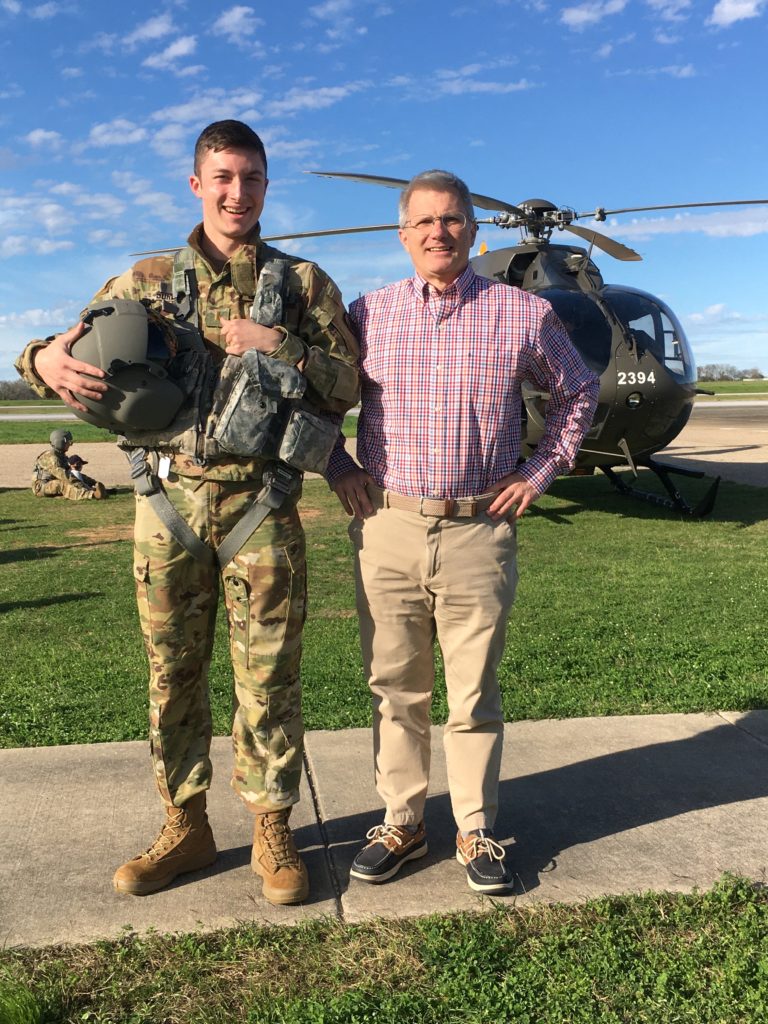
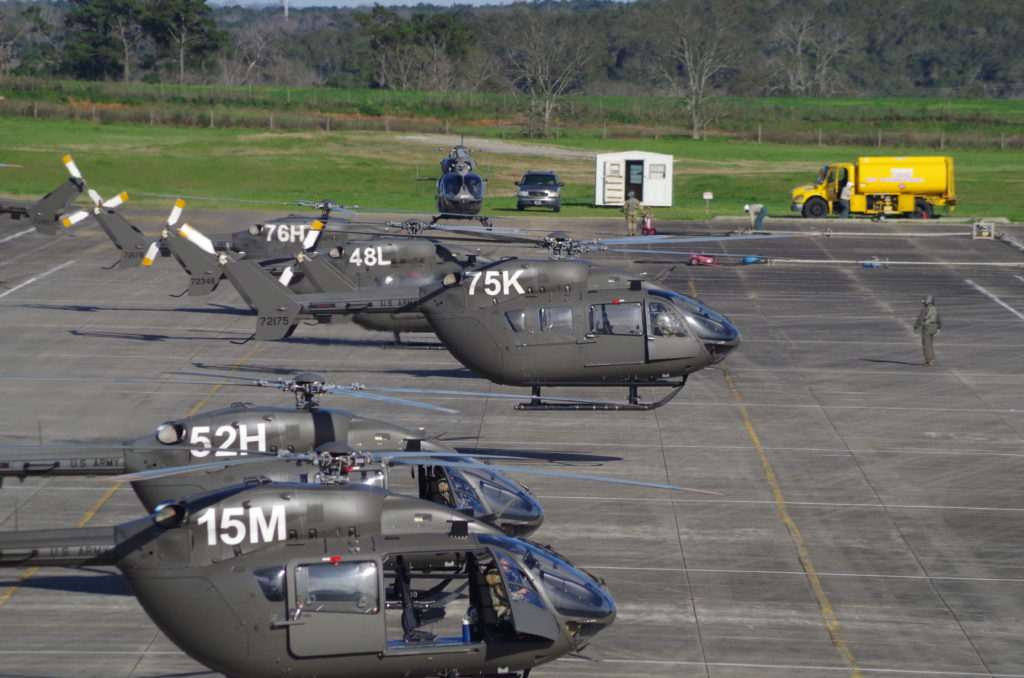
Our son is a student at US Army flight school at Ft. Rucker, Alabama. He and his classmates first got into a helicopter three months ago, after the Basic Officer Leader Course (BOLC) and Survival, Evasion, Resistance, and Escape (SERE) training. Yesterday was family day. For the students it was just another day — academics in the morning and stick time in the afternoon. Familes were invited out to Toth staging field about a half hour from the fort where we were able to watch our son training on the Lakota helicopter. In April he will find out which platform he will be assigned (e.g., Blackhawk, Apache, or Chinook). The flight school cadre did a nice job of explaining what we were seeing and what to expect. We were even allowed to go up into the control tower and listen to the air traffic controllers talking to the pilots. I just happened to be in the tower when they were talking to Tom on the radio. It was probably routine for the students, but it was a very nice event for the families. He even had a 20 minute break to get out of the aircraft and talk to us. He was assigned helicopter 75K for the day.
Tom’s helicopter for the day, 75K.The Sky God himself!Tori, Tom, and Candy in front of a Lakota.The young Sky God with the old ground pounder.Landing…After 90 minutes of flying, the students linked up on the tarmac and were allowed to come and talk to families.In the morning while the students were in academics, we spent a couple of hours at the US Army Aviation Museum, which was really quite nice.
Considering how little flight time these young officers have had, I think their skills were pretty impressive. In particular, most of them were doing a very good job at hovering, despite the windy conditions.
Tom’s class is part of an Army experiment to use virtual reality for part of flight training. We have been using flight simulators for many years, and that is still part of their training, but for the first couple of month, the VR training replaced some amount of simulator and actual stick time. I think this is an idea that will work whether or not it works, because someone has decided this is a good idea. Tom said the VR system, adapted from a commercial tool to train fixed-wing pilots, had a lot of artificialities that made transition into the cockpit difficult, but when they work out the kinks, this may turn out to be effective.
Tom demonstrates autorotation at Toth staging field near Ft. Rucker, AL.
Autorotation is an important skill for pilots. If the aircraft loses power, by manipulating the pitch of the blades, the pilot can maintain enough energy in the rotors that he can flair at the end and land safely. With a two engine aircraft, like the Lakota, you are not allowed to autorotate and land intentionally, so they came to a hover at the end.
Taking off…
I was having operator headspace and timing issues with the camera and phone yesterday (the iPhone kept defaulting to still photos, so sometimes I thought I was taking video but wasn’t). We still managed to get a few good videos.
A “running landing”
Towns outside Ft. Rucker roll up the streets pretty early, even on a Friday night, but I then took Tom and the others to a very nice Mexican restaurant with great food and amazing service.
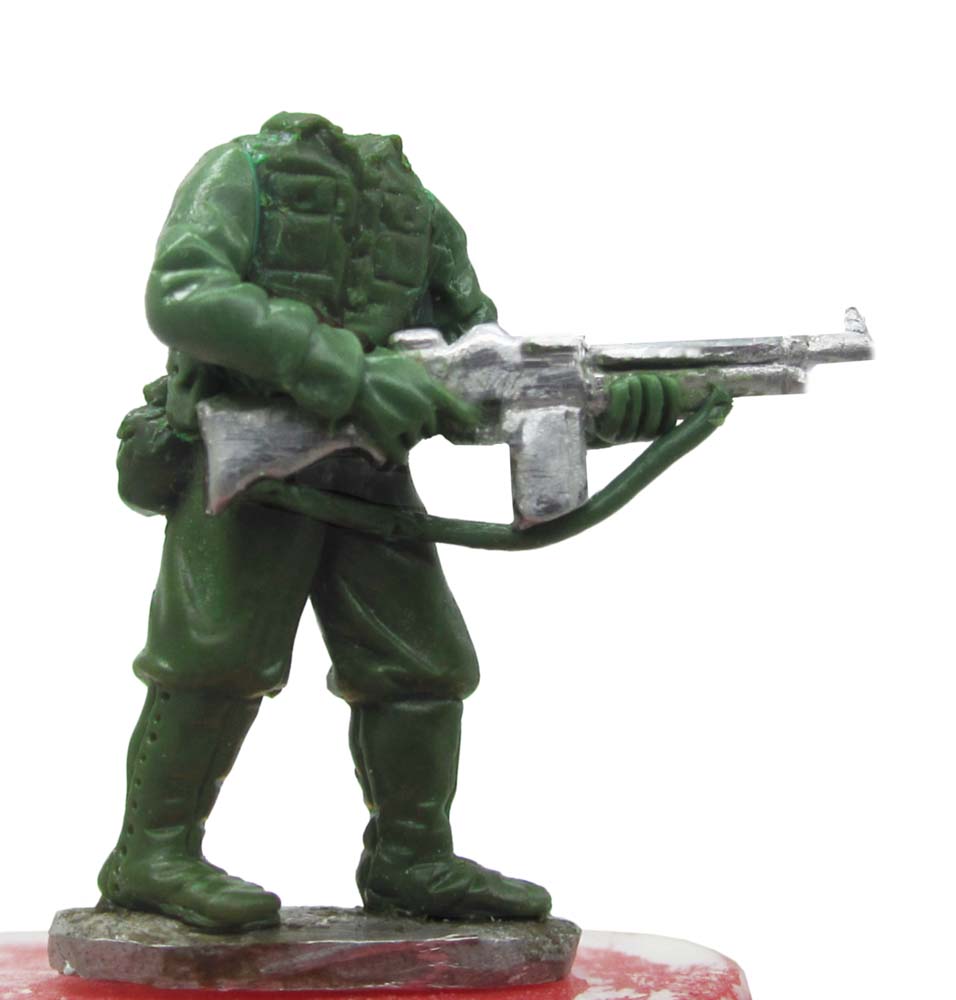
Some months ago, I posted that I was having trouble finding early WWII Americans for Wake Island and the Philippines. Several of us then commissioned Steve Barber to sculpt some. You can see some of the results here: https://www.stevebarbermodels.com/store/-c38002555
I ordered several squads of these figures, but due to a movement of my household from Maryland to Florida, I haven’t had a chance to paint them yet. Steve sent me an Email yesterday with the latest release in this line: the BAR gunner.
I really like the look of these figures. They match closely with the Pulp Figures I have and will allow much more variety. Well done, Steve!
I will post pictures of the painted figures when I have a chance to pull them from the to-be-painted box to the work table. Then you will see pictures of these in some early war Philippine scenarios using Combat Patrol(TM): WWII.
As we have been doing every year since 2009, the Harford Area Weekly Kreigspeilers converged on my house for a New Year’s Eve gaming evening, culminating in the wishing each other a happy new year at midnight. This year we played two games. The first was a science fiction game using Combat Patrol(TM). As we are in the middle of a move from Maryland to Florida, much of my hobby stuff is already in Florida. I tried to be careful about what I took down and what I kept in Maryland for New Year’s Eve, but in some cases I had taken things to Florida, like the Albedo Combat Patrol (TM) units and Eureka toy soldiers that were needed for our games, so we had to adapt.
Science Fiction Attack/Defense
Our first scenario featured Combat Patrol(TM) WWII, which works very well for science fiction games as well.
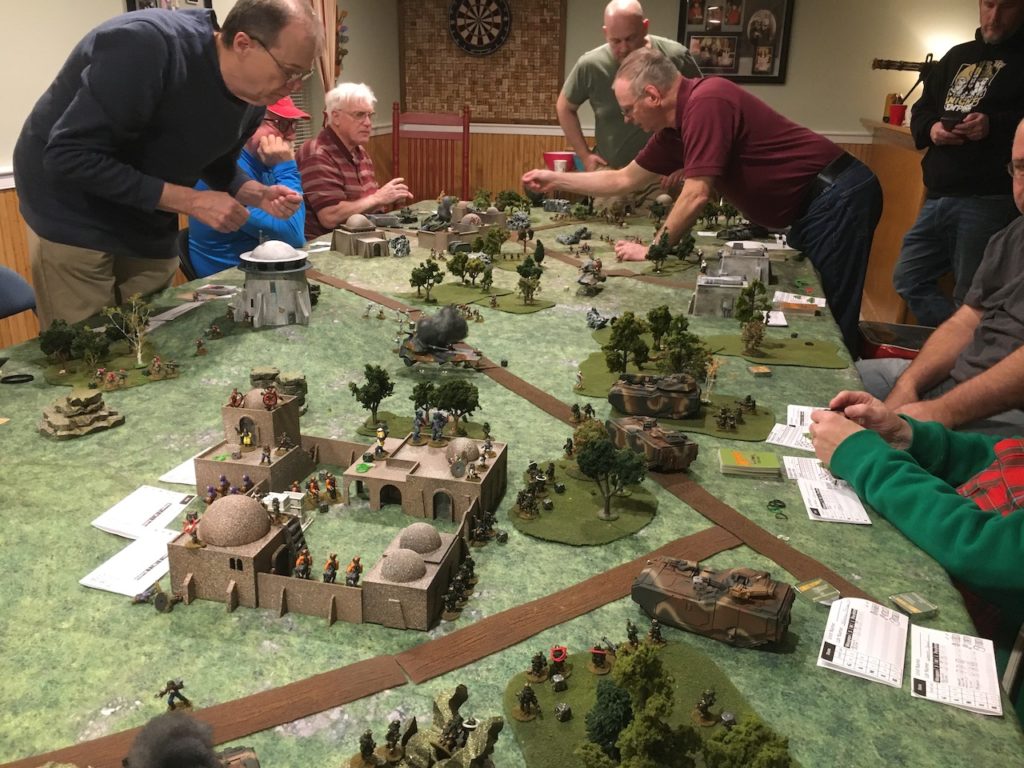
Long shot of the table.
The (mostly) human side was attacking from the right side of the table shown in the above picture. They had a full platoon of hardened soldiers, an extra weapon squad, some light tanks, a large squad of space ducks led by Duck Wader, and a reinforced squad of Colonial Marines. Their objective was to capture three supply caches. One was in the walled town in the foreground, one was near the tower in the center of the table, and one was in the walled town at the far edge of the table.
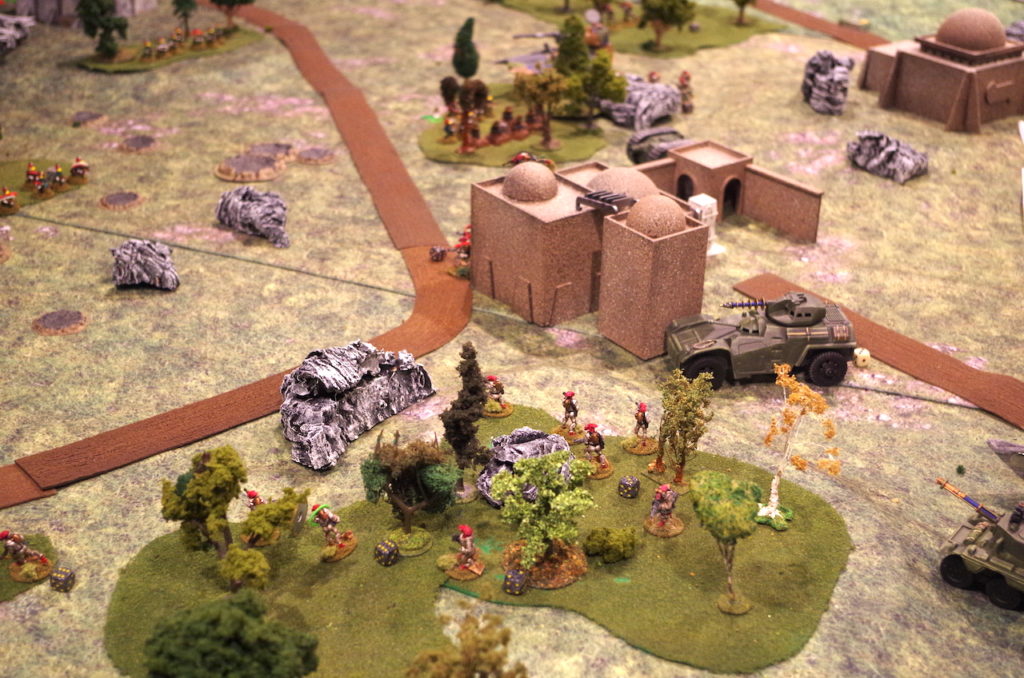
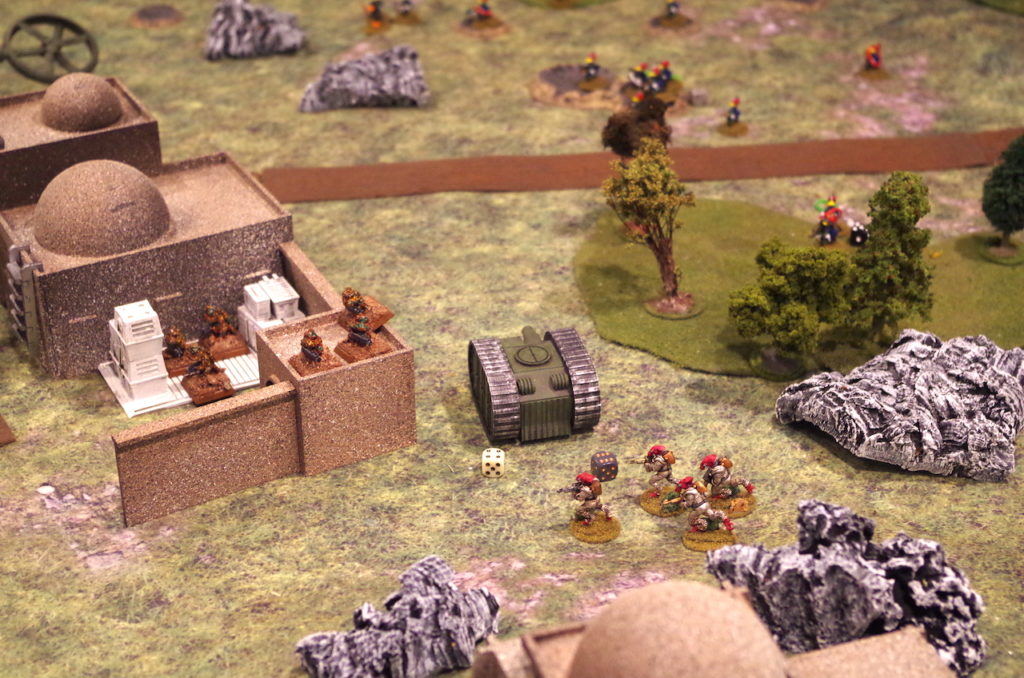
A view of one walled town with a cache of supplies. This town was defended by an ad hoc force of mercenaries (who can be seen on the far two buildings) and a team of space Dwarfs (who can be seen on the near wall).
The attackers had enough forces to attack this town, but it was a hard-fought battle the entire game.
Patrick and Geoff took it in the shorts most of the game.
The attackers had overwhelming numbers to attack the town on their right flank, between the Colonial Marines (Woodbine), space ducks (Archive), and other forces. Geoff and Patrick got slapped around quite a bit, but they were able to blunt the attack and delay the attackers long enough that they were unable to roll up the defenders’ flank.
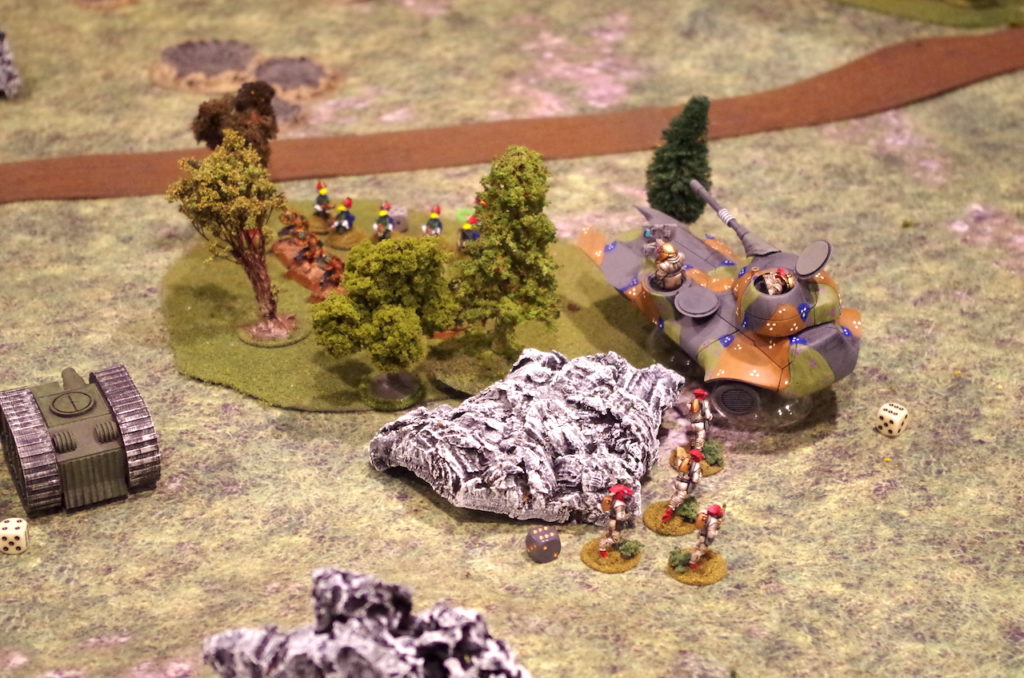
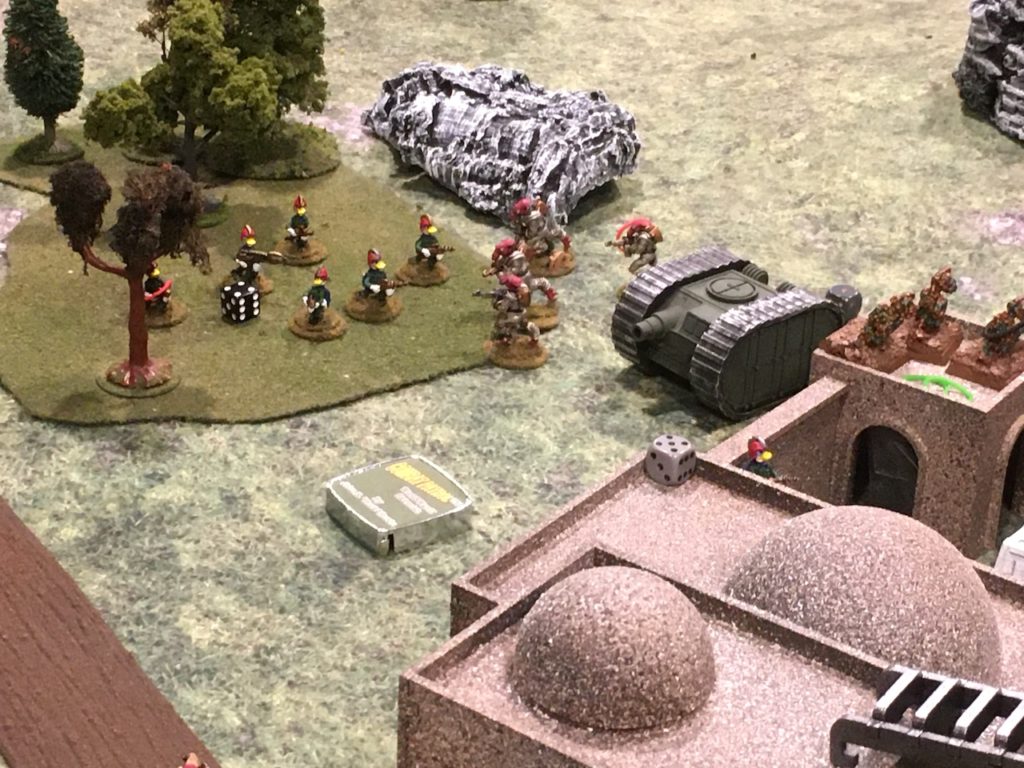
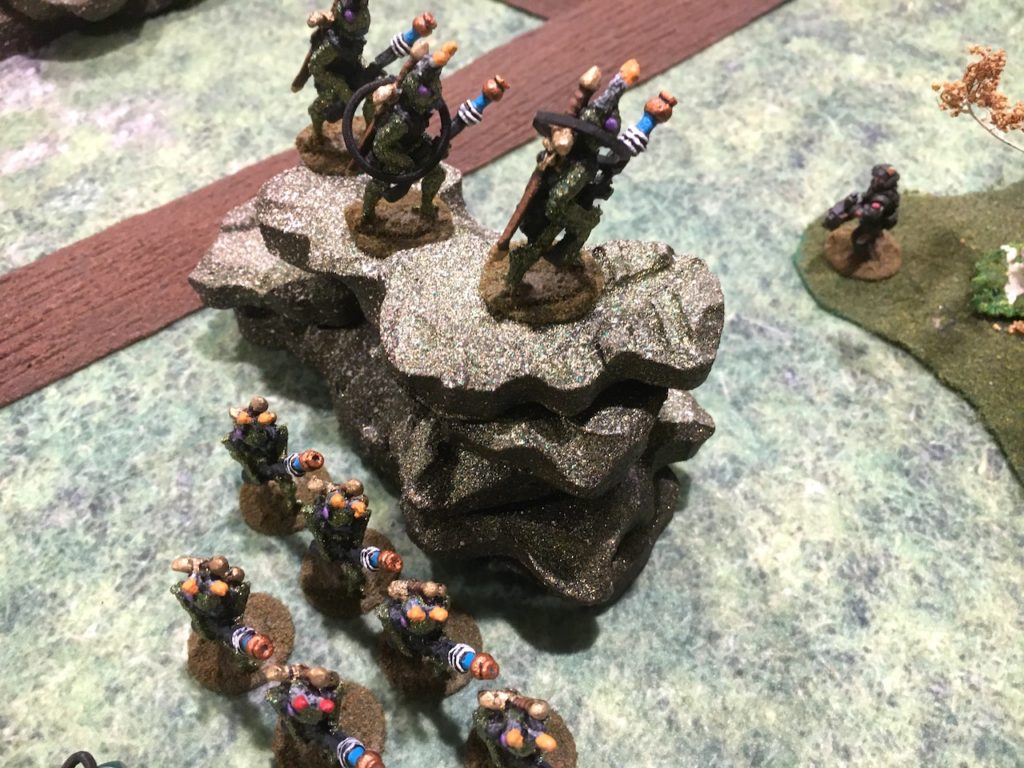
These are some of the attackers, early in the scenario, from left to right, Tom, Duncan, Eric (standing), Kurt, and Chris.A view of the defenders’ center with the tower and supplies on the left and one of the walled villages on the right.The insect men began the game near the water facility. During the game, they tried to turn the attackers’ left flank.Geoff apparently on the horns of a dilemma.The heavy infantry (Pig Iron) were supposed by three APCs and a support APC with a tank turret. The Drantakh hover tank (Badger) took TWO shots at the attacking tank but missed both times. Eventually the attacking tank got off a shot and knocked out the Drantakh tank.
On the attackers’ left, they advanced with two squads of infantry and a heavy weapon squad to attack the walled village, but the defenders were rushing reinforcements forward to assist.
Another view of the defenders’ center.Another view of the tank duel between the Drantakh and the attackers. Note that the attackers were supported by a squad of terminators (in white).A confused situation with a Drantakh tank (defenders), Drantakh infantry, a mobile engineer demolition gun (defenders), and a half squad of space ducks fighting for position in the center of the battlefield.Toward the middle of the game, a LARC (Sally 4th) entered the table full of a squad of space worms. Note the close quarters fight between the Colonial Marines and the Drantakh infantry in the woods.
In one turn, we had SIX vehicles blown up, most from shoulder-fired weapons.
The defenders move up an armored car with a ray gun to support their infantry defending their left-most supply cache.Darth Wader (Archive) leads the ducks forward.The LARC conducts a vertical envelopment of the walled town.In this picture you can see that the heavily armored special assault ducks used their jet packs to “bounce” into the town and seize the supplies.The defenders’ armored car (foreground) has been destroyed, but the fight continues.The ducks take advantage of bomb craters to advance across the open field.Advancing Drantakh counter attack supported by the demolition gun.In this picture you can see all the reinforcements that have been rushed to the village on the defenders’ right.Space bugs! Dave’s lone squad automatic rifleman held off the bugs for several turns.A long shot of the table late in the game. You can see that the attackers have gotten to the walls. In the next turn, the attackers climbed over the walls and began chucking grenades into the courtyard.Another, slightly different, view of the table. The fighting was intense, but despite the facial expressions, these guys were having a lot of fun.
The game was very fun. The defenders were defeated on their left, losing one of their supply caches. On the defenders’ right, they were able to hold onto the village by throwing in Venusian giants, space centaurs, and robot troopers to bolster the ad hoc defenders and space dwarfs. The attackers never really threatened the defenders center. I called the game a defenders’ victory.
Everyone seemed to have a good time, but after four hours of playing we called the game a defenders’ victory and set up the second game for the night.
Wars of Ozz
Both people who read this blog will know that I have been developing a set of rules, called Wars of Ozz, to go along with a new line of figures to be released by Blue Moon. While we don’t have all the figures yet, we have been using ersatz figures for rules development. Traditionally Chris runs a Santa-themed game using GASLIGHT, but this year we wanted to try it with the Wars of Ozz rules. When we reset the game, in the interest of time, we elected to leave the green cloth on the table instead of pulling everything off and putting down the white cloth.
Setting up the game.
I asked several players to bring 12-point armies. You can see in this picture a lot of War of 1812 figures pressed into service as Quadlings.
The game in mid action.
The game involved five attackers (on the right) with Munchkins, Gillikins, and Santa’s troopers attacking to seize three hills across the table. There wasn’t a lot of finesse to the scenario as we didn’t know what armies we would have, how many players we would have, or how long we would have until midnight.
We were able to play about 6 turns before midnight, paused briefly for a glass of champaign, and then 2 more turns after midnight before everyone went their own ways. After three or four turns, I was mostly relegated to answering the occasional question and making game master adjudication decisions. Most of the players had never played Wars of Ozz before, but they caught on quickly. Toward the end, one of the players who is often critical said he liked the rules and would be interesting in playing them again.
Happy New Year!
We had a very good time. With the upcoming move, I was on the fence about whether this was going to be just one commitment too many this season. I’m glad we hosted the event, and I think all the HAWKs had a good time in the basement, while HAWKs gaming widows sat upstairs in the kitchen drinking wine and husband bashing.
The focus the last two weeks has been on family holiday activities; however, in the mornings while other slept I did manage to get a few more Munchkin units painted — minus the mounted leaders which I do not yet have. These last units were painted almost exclusively with Contrast paints, as an experiment. I am happy with the results.
Colonel Sourdough’s regiment.A slightly closer view of Colonel Sourdough’s regiment.
There are four named regiments in the Munchkin army: Colonels Ticktock, Sourdough, and Hardsole plus Zoraster the Wizard’s body guard.
Munchkin Landwher, which make up the bulk of the Munchkin army.A closer look at the Munchkin Landwher
Note that Munchkin and Quadlings infantry regiments carry a national color as well as a regimental color.
A frontal view of Zoraster’s Body Guard.The rear of Zoraster’s Body Guard.
I host a New Years Eve game for my gaming club, the Harford Area Weekly Kreigspeilers (HAWKs). Our second game tonight will feature the under-development Wars of Ozz rules in a Santa themed game. We will use those figures from the Blue Moon line that we have acquired, but most of the units will be filled by ersatz figures. I will try to post pictures of the game tomorrow.
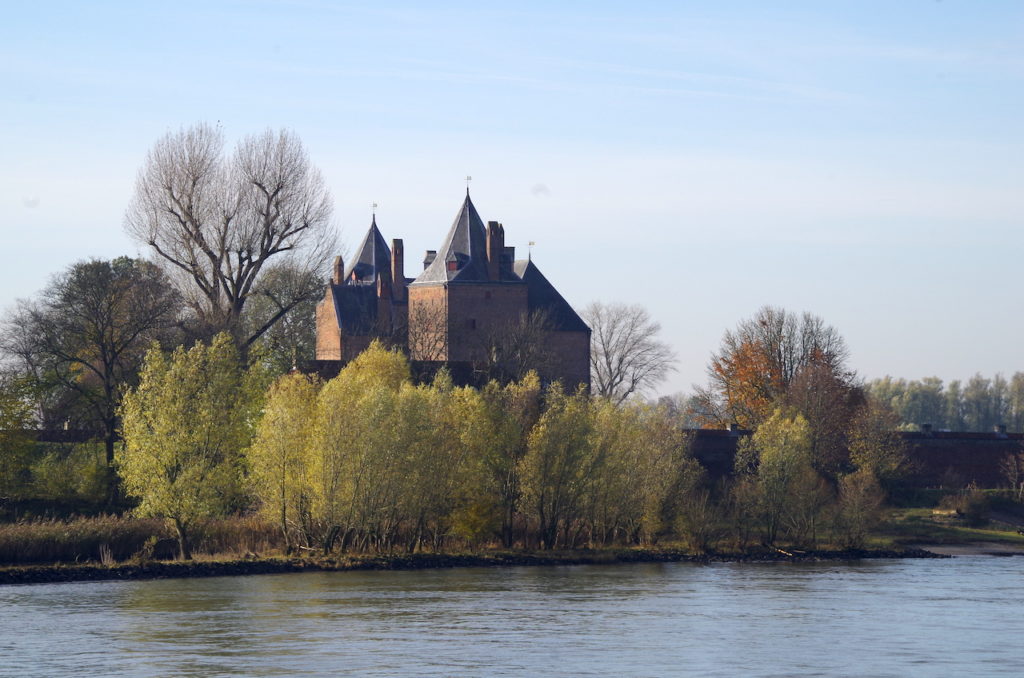
Our next full day began with a morning cruise through the Netherlands. Kinderdijk is the only place in the world with so many windmills so close together. It represents the relentless fight against the sea. From the Viking daily, “The village of Kinderdijk is surrounded by the Groene Hart (Green Heart), an extensive peat landscape right in the middle of Randstad, the bursting region of Amsterdam, Rotterdam, The Hague, and Utrecht… One of the charms of the picturesque low-lying lands of South Holland are the windmills. They are not only an innovative method of water management developed in the Middle Ages, but also iconic structure that have becoming synonymous with the Dutch landscape.”
Approaching Kinderkijk
A house along the river in the Netherlands on our way to Kinderdijk.
The first windmill I sighted during our journey.
The collection of windmills in Kinderdijk. These are working mills. Being a mill keeper is highly competitive, and it requires the residents to keep the mills running every day. While more modern pumping methods are use for water control, these windmills are their backup systems.
We got off the boat and took a walking tour of the Kinderdijk area, stopping at the visitor’s center and climbing into one of the windmills.
Greg and Nicole climbing up the windmill.
Candy climbing up the windmill steps.
Being a mill keeper are big shoes to fill. 🙂
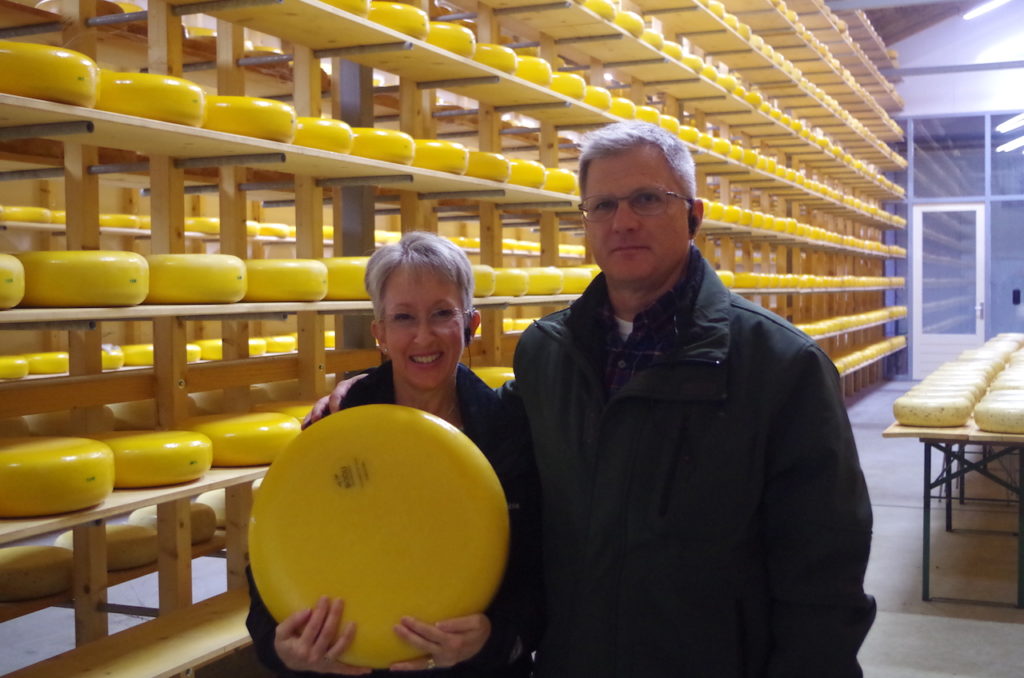
After our walking tour of the windmills, the four of us took a bus tour to a family-owned, small cheese factory nearby. We had a chance to sample some cheese and see how cheese is made.
Cheese loafs that are waiting to have the rind applied.
On a bet, Candy ate the 25-pound block of cheese. It was impressive — but a little gross.
Kinderdijk at dusk.
We returned to the boat a little after dark for another terrific meal. This was our last night aboard ship. During the night we docked in Amsterdam. We had a nice, light breakfast in the lounge and then took a bus to the airport for our flight home.
It was a great trip, and we will certainly take another Viking river cruise in the future. It was really nice to be in a floating hotel room and be in a different city each day. The service was terrific, the food was excellent, and the whole experience was wonderful. It was also a lot of fun to share the experience with another couple.