Cologne, German

The next morning, 24 November, we were docked on Cologne, Germany. From the Viking daily, “An intriguing mix of old and new, Cologne reveals its Roman heritage in its city layout and the ancient ruins that lie scattered through the town. Cologne’s modern plazas and Hohe Strasses, a pedestrian-only shopping zone, host welcoming shops, enticing restaurants, and of course, cologne boutiques. Of particular note is the city’s 14th century cathedral, a stunning example of Gothic artistry… Spared Allied bombs during World War II, the cathedral’s imposing twin spires are visible for miles; stained glass windows felt he interior with brilliant colored light. Its 509 steps lead to the 312-foot platform with astounding views.”

The cathedral.

Being Sunday, most of the shops were closed, but we did get some food in a bakery. Some of the stores catering to tourists were open, so we did a little shopping. We also found a cafe for a nice lunch.

One of the entrances to the cathedral.
The cathedral is an active Catholic Church.

Cologne is renowned for its wealth and boasts over 100 traditional brew pubs. While Bavaria is famous for the large mugs of beer, in Cologne small glasses are common. In Cologne they like their beer cold, so they serve it in small glasses so the beer doesn’t get warm. The waiters will keep bringing beer when your glass is empty unless you place a coaster over the glass.

The Christmas market wasn’t open yet for the year, but we saw a lot of the construction and preparations.
One of the many squares in Cologne that would be host to the Christmas market the next weekend after our visit.

From the Viking daily, “The history of Cologne’s signature beer is an interesting one. In 1603, the city passed a law stating that only to-fermented beers — that is, ales — were to be brewed within its limits. The reasons for this are unclear, thought many hypothesize that, without any means of refrigeration, the city’s climate was not able to accommodate lager brewing’s necessary fine-tuning of the beer’s fermentation temperature. Whatever the logic behind it, this law allowed few medieval styles of German ale — forerunners of today’s Koelsch to survive into modern times. The first instance of the word Koelsch used to describe the city’s trademark brew can be tracked to 1918.”

Another view of the Cologne cathedral from the side.

The term “cologne” originated in the city of Cologne, and we purchased some as a souvenir; although, we were told that the scent is considered old fashioned these days.
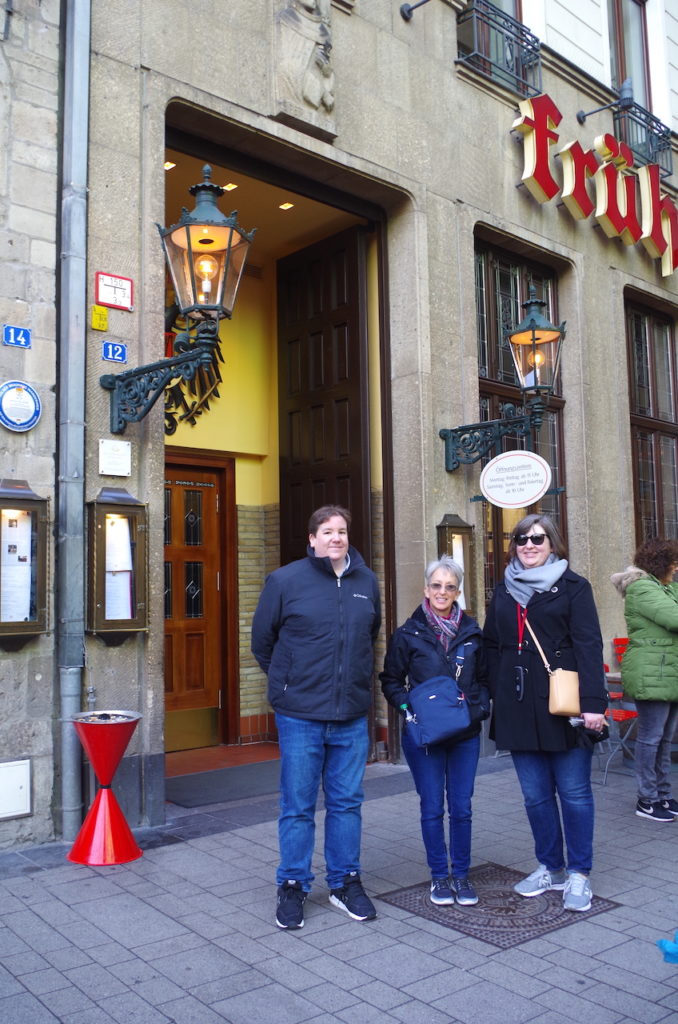
A mostly crew in Cologne.
We had a nice lunch in a restaurant near the cathedral before wandering back toward the boat.
Prost!
The stained glass window of our restaurant.
After lunch we walked through the old part of town looking at the preparations for the Christmas Market and looking at the various shops, restaurants, cafes, and brewpubs along the river.
Greg and Nicole in the tall building overlooking Cologne from the opposite side of the river from the cathedral.
Candy and her trophy husband.
A view of our boat from the tower.

After our walk, we returned to the boat for a little down time. While everyone else was being a slug, I put on my running gear and ran along this side of the river. The path ran along the river, and there were lots of German walking, running, and pushing strollers. I ran through a few parks. Later we had another great dinner about our boat as it began our journey for the night.
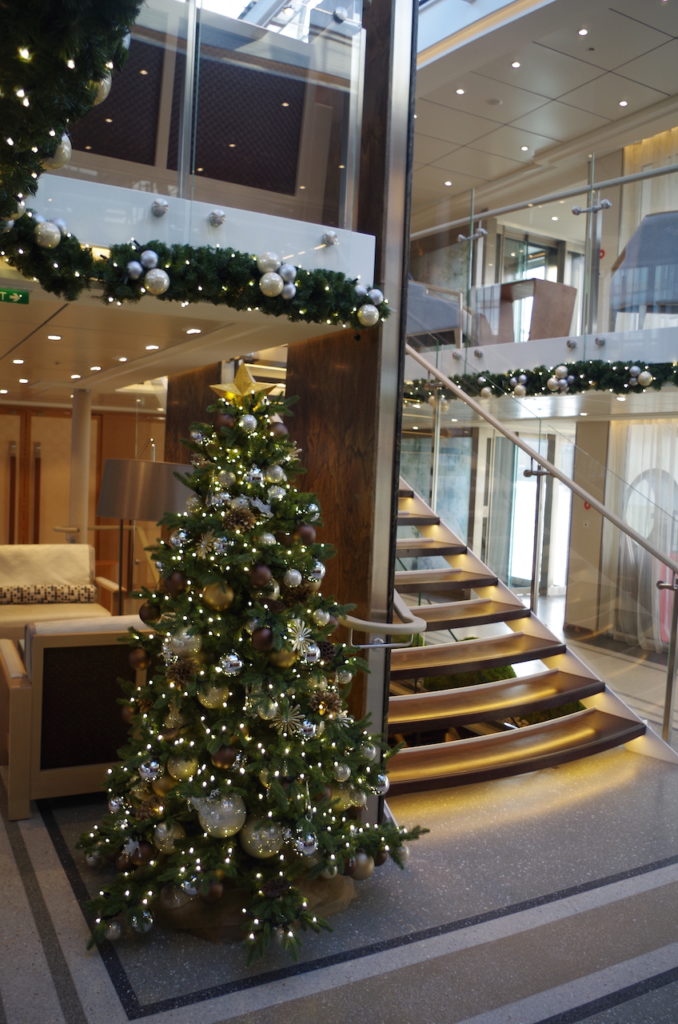
While we were walking around Cologne, the crew was busy decorating the boat for Christmas.
Cologne from about our boat just before leaving dock.
The four of us in the lounge that evening before dinner.

Koblenz

The next day, 23 November, was the first time we travelled in daylight. Until then, we travelled at night and were docked in a new location by morning. We traveled along the “Middle Rhine” while our program director, Andrew, narrated descriptions of the various castles along the river.

Rudesheim the next morning before setting sail. The white tower is the one I showed in the previous post that was lit up when we went to visit the Christmas market.
Leaving Rudesheim
You can see Andrew, the program director, on the bridge narrating our passage of the middle Rhine.
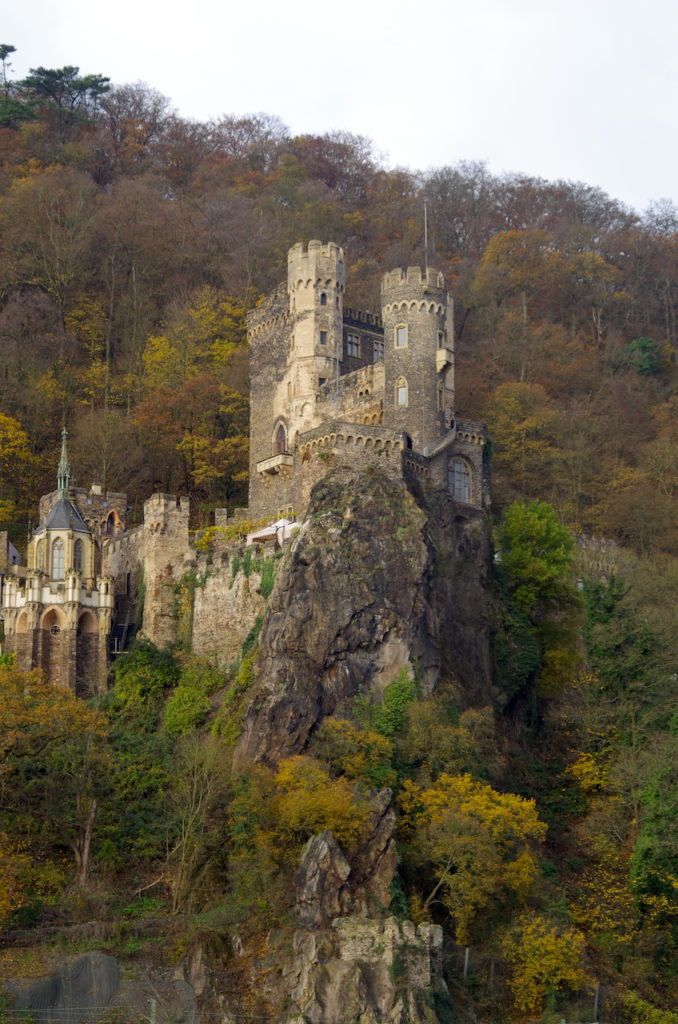
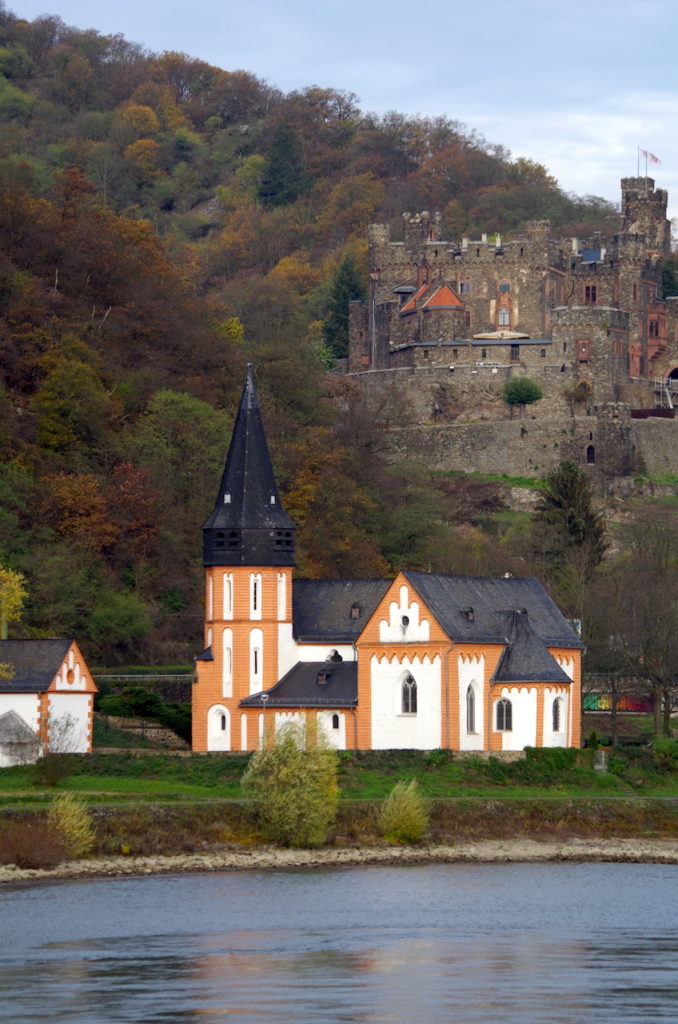
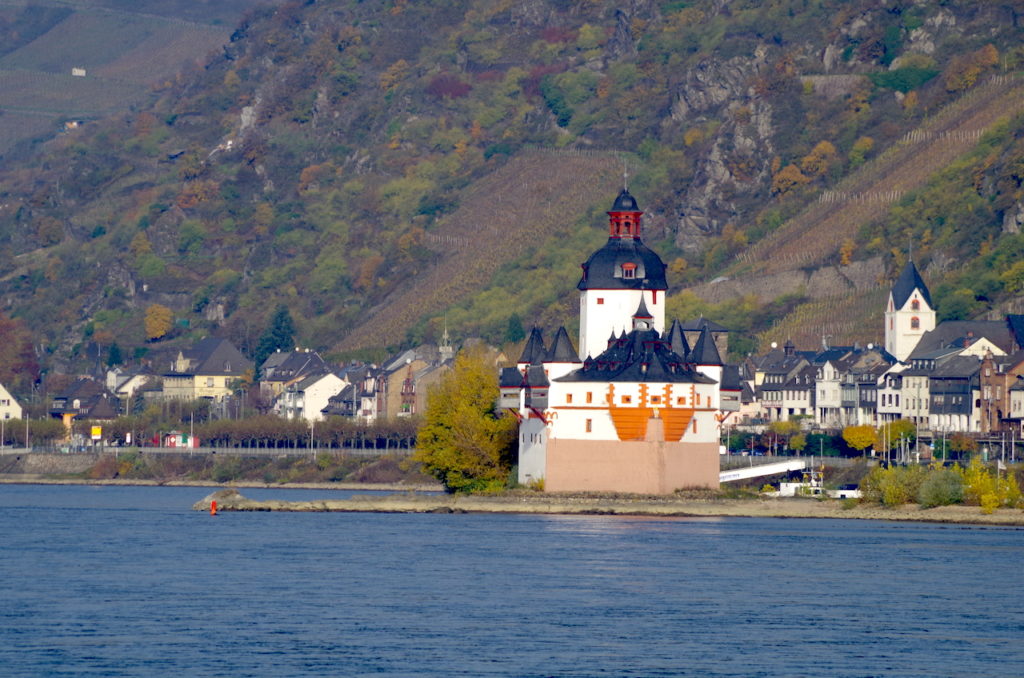
One of many castles we viewed from our boat while traveling the middle Rhine. There were a mix of ruined ones like this one and ones that had been renovated as hotels or residences.
Most of these small castles and towers were used to control customer and excises along the river. In many cases two or three were visible from each other, so traveling the Rhine must have been a constant series of stops to pay tolls, taxes, and bribes.
Candy and Nicole trying to stay warm while I took pictures of an endless series of castles, towers, and keeps.
This part of the Rhine was wine country. You can see terraced vineyards in many of these pictures.
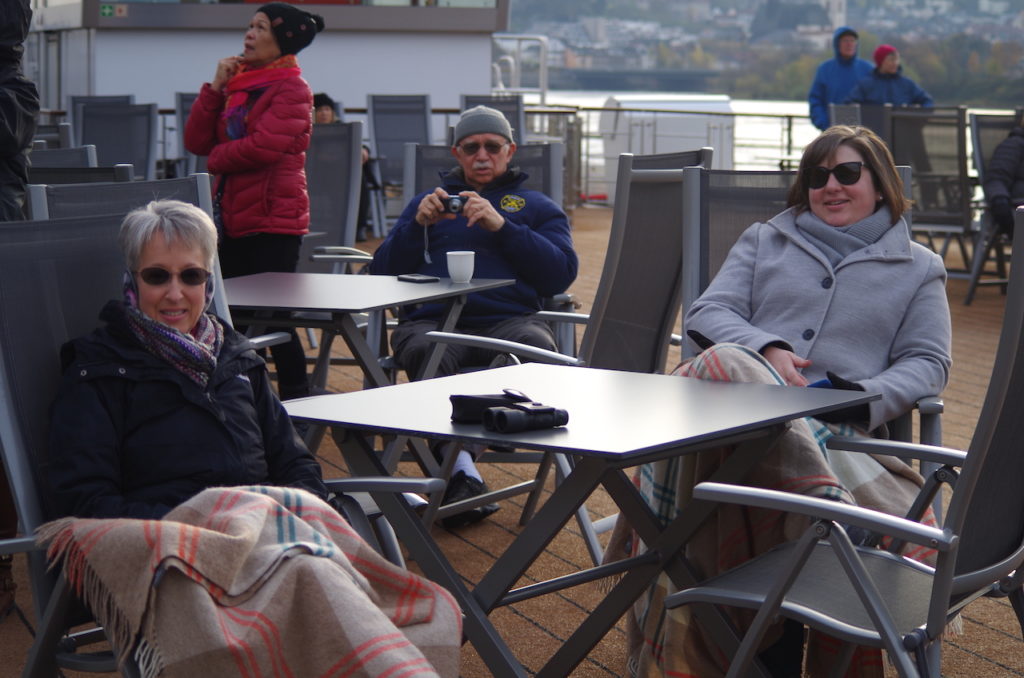
Candy wasn’t thrilled with the cold weather, but at one point the wait staff brought hot berry tea with rum in it to help us stay warm on deck.
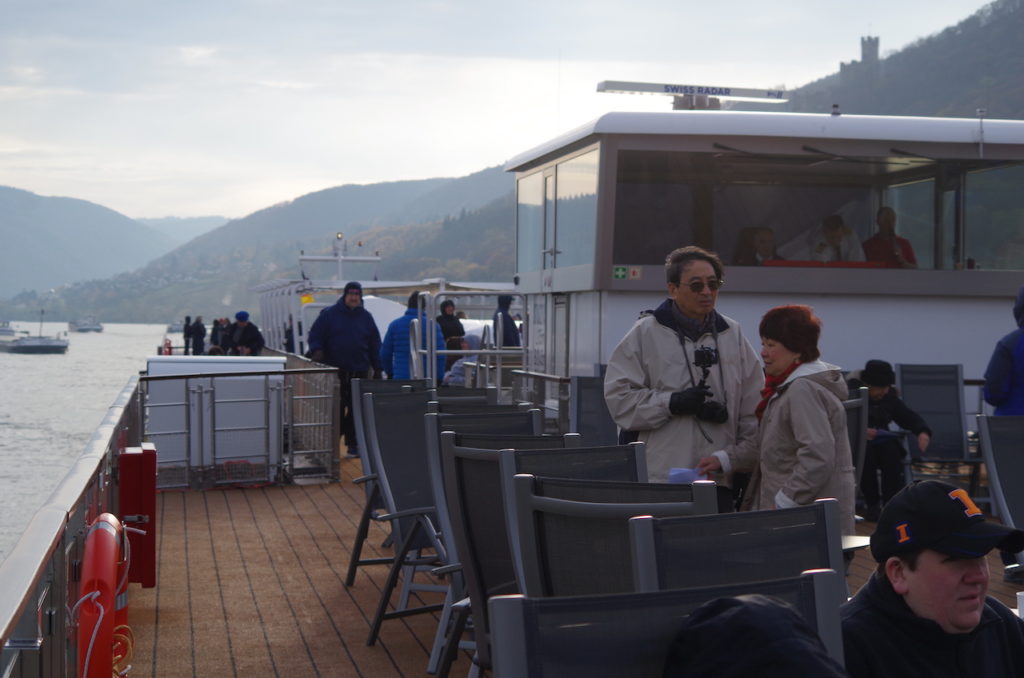
You can see down about 2/3 of our boat.
This picture shows a nice view of the terraced vineyards.
I like the combination of brick and stone on this one.
This turn in the Rhine was once particularly treacherous and accounted for many crashed boats over the years.
During WWII, the Allies bombed a lot of railroads to impede the Nazi war effort, but they attempted to avoid bombing cultural features. The Nazis began disguising many of the train tunnels like castles to confuse the Allies into thinking they were cultural features, so they wouldn’t bomb them. This is one of several examples that remain along the Rhine.
Here is another example of a train tunnel disguised as a castle to confuse Allied bombers.
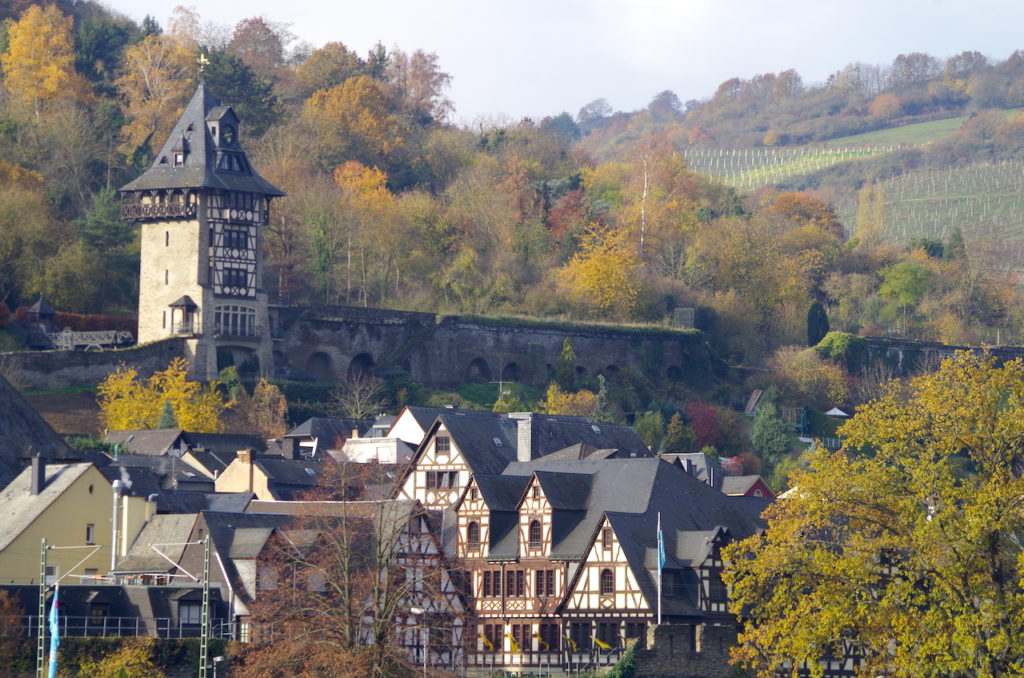
I just love the look of half-timbered buildings.
Approaching Koblenz

Our journey along the Rhine ended in the city of Koblenz, Germany. From the Viking daily, “Koblenz is a traditional German country town at the confluence of the Rhine and Moselle rivers. Founded more than 2,000 years ago, this former trading settlement rests on a massif of the Middle Rhine Highlands. Its cobblestone streets, wood-beamed houses adorned with flowers, ancient market square, and medieval churches recall the fairy-tale Germany of old. At the “German Corner,” Deutsches Eck, where the two rivers converge, a massive equestrian statue of Prince William I observes the lovely riverside scene The famed Teutonic Knights set up their first base here in 1216. The Romanesque Basilica of St. Castore, Koblenz’s oldest building, dates to 836.”

The statue of William I at the German Corner.

Greg and I signed up for the optional excursion to visit the fortress of Ehrenbreitstein, and the girls were on a different excursion to see Marksburg Castle. Greg and I had about 90 minutes between when the girls left and when we were to depart, so we walked off the boat a couple hundred meters to the German Corner to get a closer view of the statue.

Greg and me in front of the statue of Prince William I.
This is our boat. We were parked in the closest dock to the German Corner.
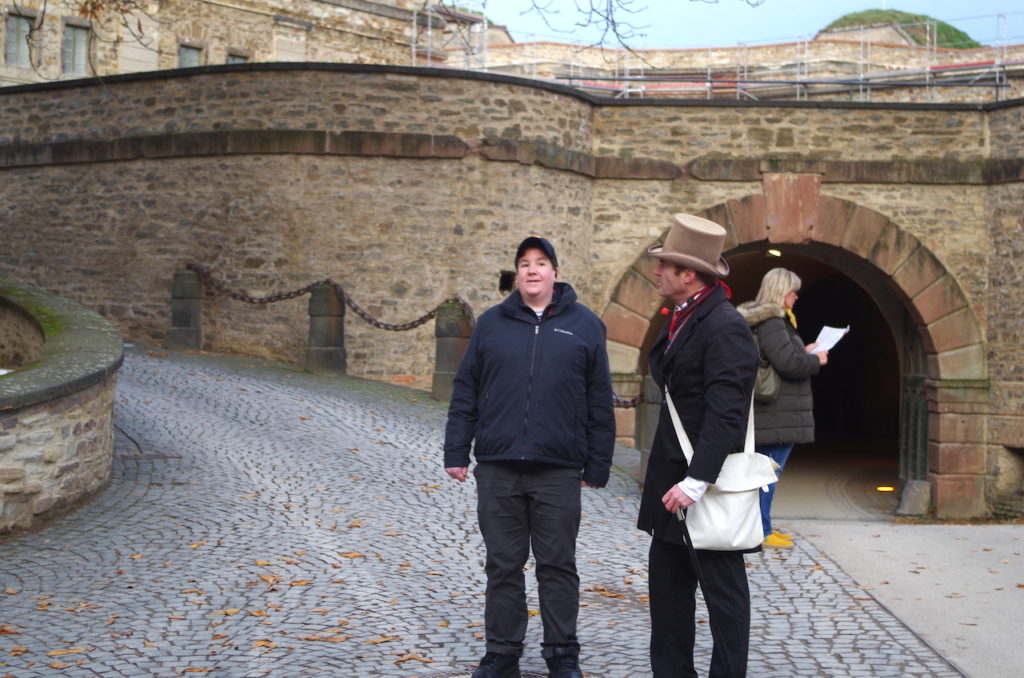
Our docent, role playing a (real) British Major who spied on the construction of the fortress and published a book on the fortification.

From the Viking daily, “Set on a hill overlooking the Deutsches Eck, the “German Corner” where the Moselle and Rhine Rivers meet, Ehrenbreitstein is Europe’s second largest preserved fortress. The hill upon which it rests was settled as far back as the 4th century BC, and a Roman fortification existed there around 400-500 AD. Constructed on the current fortifications was begun around 1100 and expanded during the 16th century. In 1801, Ehrenbreitstein was partially destroyed by Napoleon, and the French occupied Koblenz for the next 18 years. The fort looms some 400 feet above the Rhine’s left bank.”

Greg on guard duty.
A model of the fortifications.
Greg had to sing the Marseilles and charge the fortifications with our docent.
Our boat parked next to the German Corner from Ehrenbreitstein.

After dinner we had a few hours before our boat was going to shove off, so the four of us walked into the old town of Koblenz to enjoy their Christmas market and more great German food.

Heidelberg and Rudesheim

The next day when we woke up, the boat was docked near Heidelberg, German. We took at bus into town and a walking tour of the ruined castle and the old part of town.

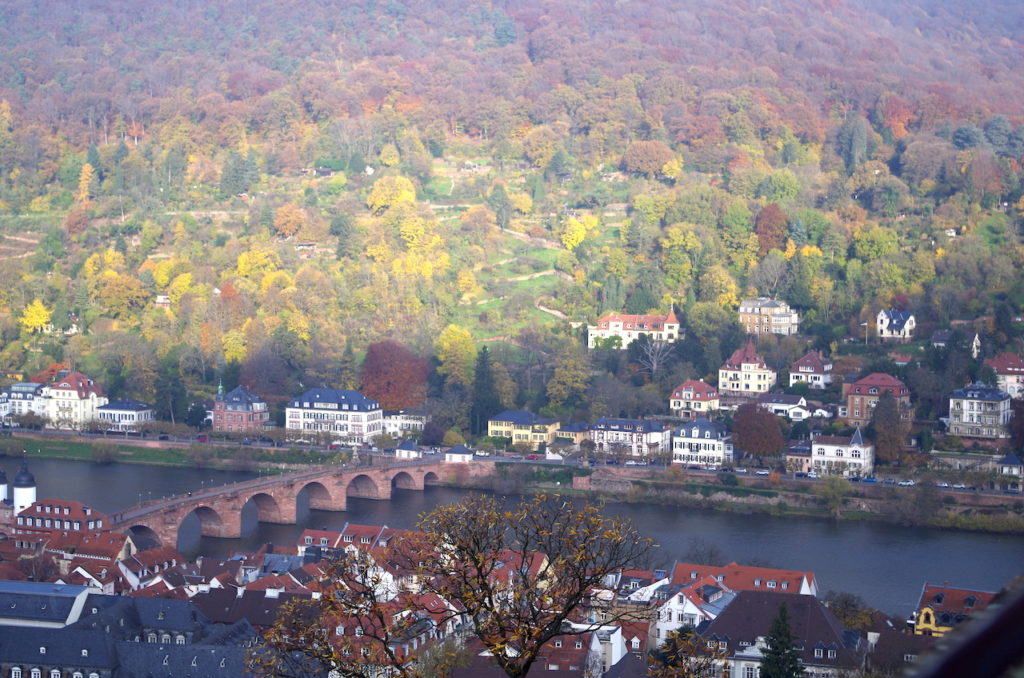
A view of town from the castle.

From the Viking Daily for Heidelberg: “Heidelberg is unquestionably one of Germans oldest and most unashamedly romantic cities. Famous for its historic university, it boasts may other obvious attractions, such has its beautiful baroque Old Town and the magical, partly ruined fairy-tale castle that overlooks it. With a history as dramatic and romantic as its Gothic-Rennaissance character — of of palatinate princes, stampeding Swedes, Protestant reformers, raging fires, and lightning bolts — it is little wonder that the castle serves as inspiration for artists and writers alike during the late 18th and early 19th centuries. It is still home to the world’s largest wine barrel, a 250-year-old vat shaped from 130 oak trees that once held 50,000 gallons of wine… Heidelberg was left in ruins by French troops one the command of Louis XIV. It was totally rebuilt during the 18th century, give us three picturesque cobblestone streets lined with half-timbered houses and baroque buildings that remain in the Old Town.”

Candy, Greg, and Nicole in front of the Heidelberg castle. It was COLD.
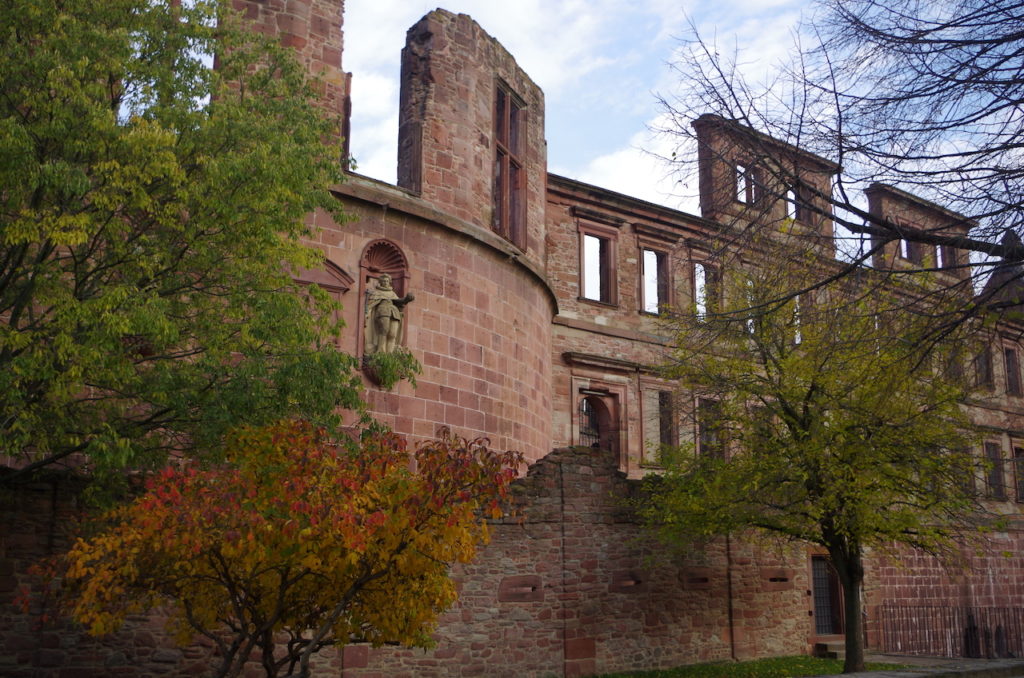
Another view of the castle ruins.
The main building of the castle is available for a walking tour, as it has been partially restored.
Inside the main hall is the world’s largest wine barrel.
Another view of the city from the castle grounds. There is another picture of that bridge later in this post.

The walking tour was short, and I felt like I would have liked another hour on our own in town. This portion of the cruise seemed rushed.

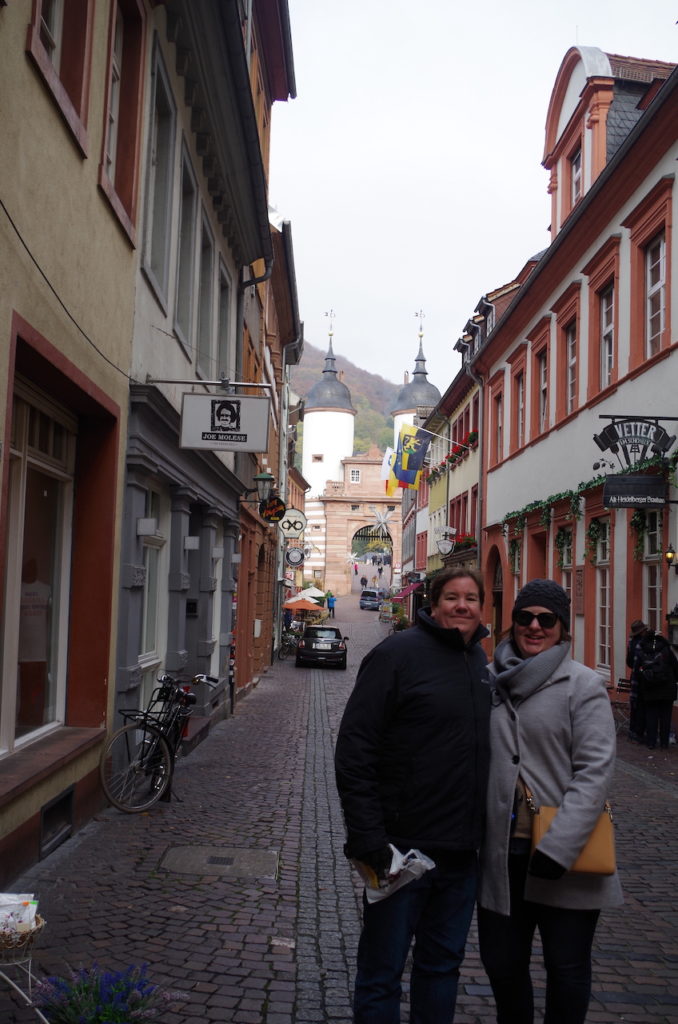
Greg and Nicole with the towers of the bridge behind them.
Candy and me a little closer to the bridge.
The original Kathe Wohlfahrt store. If you don’t know these stores, this is where you can order very nice, made in Germany, not China, nutcrackers, smokers, and other traditional Christmas decorations. They have satellite stores that show up in Christmas markets in Baltimore, Bethlehem, PA, and other festivals in the US.

We had 15 minutes of free time after walking around the old town (briskly) and the bridge, so we popped into a bar, called Vetter. They serve the beer with the highest alcohol content in the world: 33%. Yes, 33%, not 33 proof. It was very mild and smooth tasting, thick like a stout, but not bitter. In fact it tasted sweet.

A giant Christmas pyramid in one of the town squares that was being set up for their upcoming Christmas market.

That evening the boat docked at Rudesheim, German. We elected to leave the boat and experience their Christmas market. Most other towns started the market after our cruise, but this one actually started the day before we arrived. We had a very nice time winding our way through the byways of Rudesheim, sampling the food, and looking at souvenirs in the various street stalls.

Nicole and Candy enjoying gluwein in Rudesheim.

Greg and I were on the prowl for curry wurst, which we found and enjoyed.

Curry wurst! Yum!
The tower near the entrance to the part of town where the Christmas market was being held that we used to help find our way back to the boat.

We had a very nice time wandering around the Christmas market. It rambled through the city, so every time we turned a corner, there were mall stalls and shops. We spent about two hours in town before returning to the boat.

Strasbourg

There has been a really long delay in me finishing the blog posts for our Viking river cruise of the Rhine. The Internet onboard was very, very slow, so I couldn’t keep up along the way. When we got home, life went back into overdrive with Thanksgiving, Christmas preparations, and the move from Maryland to Florida.

Our next stop was Strasbourg. Candy and I elected to take the optional “Taste of Alcase” tour. This involved the normal walking tour, but we also stopped at several shops for food sampling.

Strasbourg is a medieval town that was mostly spared during WWII.

Our guide walked us around the old, medieval part of the city. Our first stop was a gingerbread shop where we learned about the various spices that go into gingerbread, tasted different types, and purchased some for our upcoming Christmas party.

The proprietor of the gingerbread shop talked to us about how gingerbread is made.
The exterior of the gingerbread shop.
Having “torte flambe,” which is sort of like French pizza without the tomato sauce. I really liked it!

Our next stop was a small French cafe. Our guide took us upstairs to a semi-private room where we were treated to “torte flambe.” This is sort of like French pizza. A creamy cheese sauce is spread over thin dough and then covered with onions and bacon and then baked on high heat for just a few minutes. They were really good. We tried several different toppings, including a sweet version as dessert. I don’t think we would have tried this dish or found this restaurant without a guide.

Out guide leading us around town.
Another view of the town.

We were a weekend too early for the Strasbourg Christmas market / festival, but the town was largely decorated for Christmas. Most of the shops had decorations and festive window displays.

The Christmas display in a shop window.

Our next stop was the magnificent Notre Dame cathedral in Strasbourg. The mechanical clock was amazing, the way it tracked moon phase, day, date, time, and motion of the stars.

Interior of the cathedral in Strasbourg.
A view of the magnificent clock.
Vignette 1 of the Strasbourg nativity
Vignette 2 of the Strasbourg nativity

The cathedral had an amazing nativity on display. I have never seen one that depicted five scenes before. They usually focus on just the manger scene.

Vignette 3 of the Strasbourg nativity
Vignette 4 of the Strasbourg nativity
Vignette 5 of the Strasbourg nativity

After visiting the cathedral, our guide walked us around various shops. At one shop we picked up bread, at another desserts, and and another cheese.

The woman in the cheese shop describing the various types of cheeses and ingredients used to make them.
Candy in front of a giant wine barrel in one of the town squares.
At one point we stopped to look at this model of the city. You can see one of the people on the tour with us carrying the bread we picked up at the bakery. I was carrying the heavy cheese. Someone else had the desserts.

In some of these pictures, you can see that we are all wearing ear pieces, and the guide is wearing a small microphone. This allowed him to talk to us without have to shout or bother others not on the tour. I also allowed us to hear without having crowd up to him.

Our group had a nice wine, cheese, bread, and desserts dinner at the wine shop in Strasbourg.

The Taste of Strasbourg tour culminated with a dinner at a winery in town that included the wine, cheese, bread, and desserts we had been picking up along the walking tour.

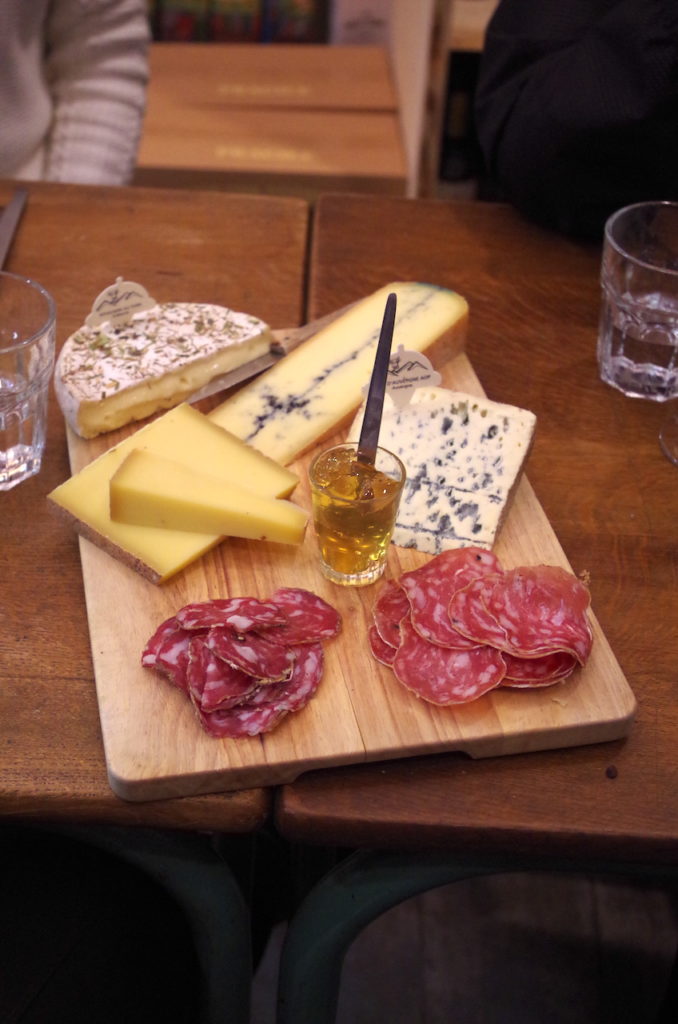
One of several plates of meats and cheeses.

This was a very nice tour, and we saw things we would have been unlikely to discover on our own. My only complaint is that it wasn’t a taste of Strasbourg, it was two full meals. I think they could have cut the amount of food in half without detracting from the tour, and we wouldn’t have felt so bloated at the end of the day. The meal on the boat was the one I had been looking forward to — Bavarian food buffet — but we were so stuffed from the tour that we really couldn’t enjoy the dinner.

Colonel TicToc’s Regiment

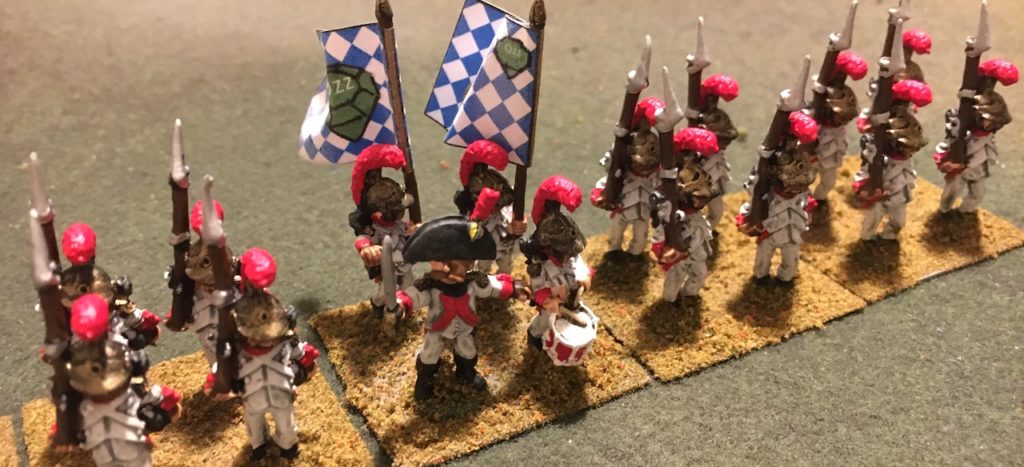
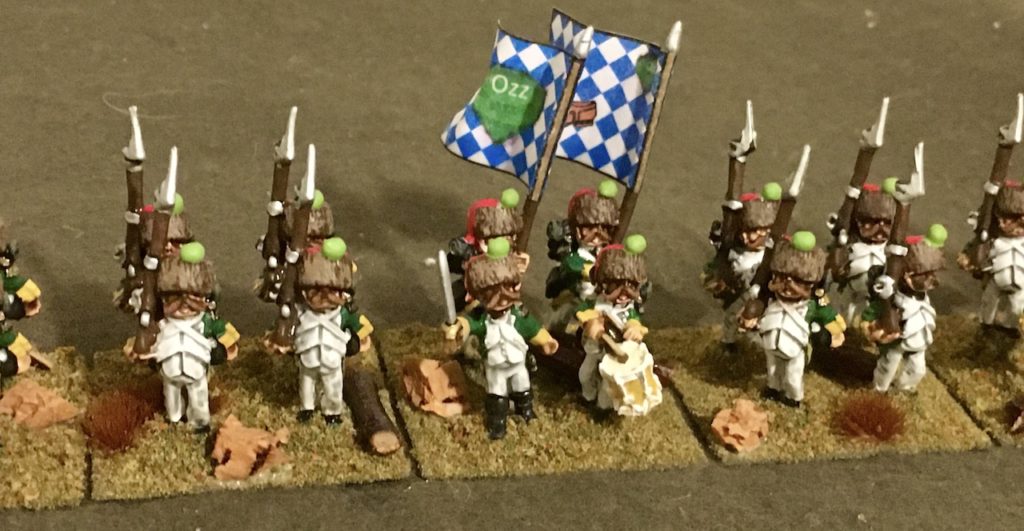
Despite a lot of business travel and preparations to move households, I managed to complete another regiment of Ozz figures from Blue Moon. This is Colonel TicToc’s regiment. These will be released for sale in March. In the meantime, development of the Wars of Ozz rules continues apace. This regiment is missing the mounted Colonel TicToc, but that will come soon.

Close shot of the center of the regiment with the command group
The regiment in line
Another view of the regiment in line

An infantry regiment in Wars of Ozz generally consists of five infantry bases, with four figures each, plus a mounted colonel. This gives the table a really nice, old-school look.

I have two more regiments on the painting table that will be completed before Christmas.

When figures are sold, a box will come with a sheet of flags.

First Unit of Blue Moon Munchkins: Colonel Hardsole’s Regiment

I have been collaborating with Old Glory to produce a set of rules, The Wars of Ozz, to go along with the beautiful new line of figures that will be hitting the market in the Spring. Most of the testing has been with ersatz figures, but recently I received some pre-production figures of four Munchkin regiments. This one if Colonel Hardsole’s Regiment. I am afraid my painting doesn’t really do justice to these beautiful figures.

The front of Colonel Hardsole’s Regiment in green coats with yellow facings.
A closer look at the regiment.

All infantry regiments in Wars of Ozz are mounted in five bases with four figures each. Shooting and melee are conducted by base, but damage is assessed by individual figures. There is also a mounted commander for many regiments, not pictured here.

Three more regiments, partially completed, on the painting table.

These figures are fun to paint. The rules are coming along nicely and will be released (hopefully) at Cold Wars or soon afterward. In any event, I and those to whom I have subjected months of play testing, will be running Wars of Ozz games at Cold Wars.

Breisach, German

Our first full day on the Sigyn was a Breisach, German, the “gateway to the Black Foreset.” Breisach is built on a basalt rock outcropping in the Rhine plain. It is located in one of the warmest parts of German, across the river from French Alsace, which is famous for its wine growing. Breisach, too, can boast about its winter; it is home of Europes largest cellars, which a storage capacity of more than 160 million liters. The most prominent landmark of Breisach is the Romanesque-Gothic St. Stephen’s Cathedral , built between the 13th and 13th centuries.

We took the included excursion into the Black Forest, which is actually a mountain range. Due to weather, we were not allowed to hike the Black Forest trails, so we instead viewed a glass blowing a cuckoo clock demonstration in a tourist area in the Black Forest.

A view of the Black Forest from our bus window.
Sheep seen from our bus.
The Black Forest Village tourist trap where we saw the glass blowing and cuckoo clock demos.
The “newlyweds.”
The not-so-newly weds.
The people danced around the clock on the half hours.

In the afternoon, Candy and Nicole went on the tour of Medieval Colmar tour, but Greg and I took the WWII Colmar excursion.

The site of Audie Murphys one-man stand against the Germans.
Our guide, Malcolm.
A plaque at the Audie Murphy site.
One of the many dioramas at the WWII, Colmar museum. This was an interesting chapter of WWII history that I didn’t know much about until this trip.
Another diorama.
Greg and me in one of the Alsacians towns we passed through during our travels.
A French Sherman that was knocked out by the Germans and was on display in a French town.
A church in Medieval Colman where Candy and Nicole toured.
A woman Medieval Colmar passing out coconut macaroons.
The town was beginning to decorate for Christmas.
Another view of Christmas decorations.
The tour guide herds cats.
One of the early versions of the Statue of Liberty. This was the town in which the sculptor lived.
Nicole and Candy in the lounge back on board.
Candy disproving new alcoholic treats under the expert tutelage of Nicole.
The evening’s entertainment consisted of a glass blowing demonstration in the lounge.

It was a good, but long, first full day aboard ship.

Traveling the Rhine (continued)

Our last day in Lucern we checked out of our hotel and then walked round the old town (altstaedt) to do some shopping. By 1500 we boarded busses for the 90-minute drive to Basel, where we boarded out boat, the Viking Sigyn, unpacked, received the introductory briefing by Andrew our program director, and had dinner.

A view of downtown Lucern.
A view of the shopping area in the old town.
The lion statue carved into rock to honor the Swiss soldiers who served the French during the Thirty Years War.
At one point we stopped to get a small bag of roasted chestnuts. The weather was cold, and the nuts were welcome.
One of the many churches in downtown Lucern.
Candy and Nicole with their loot.
We had a nice lunch in a restaurant that specialized in local Swiss beers.
A humorous store window.
Boarding our home for the next week.
Our state room.

Switzerland and the Rhine

I have never had any interest in taking a cruise. First, the Caribbean holds little interest for me. Second, the notion of sitting on a private beach in an all-inclusive resort while abject poverty stares at me through a chain link fence just doesn’t interest me. Some friends of ours took a Viking river cruise of the Danube a couple of years ago and came back with glowing reports. We decided to give a Viking river cruise a try by traveling from Basel to Amsterdam along the Rhine with stops every day for excursions and sight seeing.

The trip began with two days in Lucern after a flight into Zurich. The first day was raining and cold, but we had nice weather for the second day. While we waited for Greg and Nicolle to arrive, we got a quick bite to eat at the nearby train station, I worked out for an hour in the fitness center, and I talked Candy into experiencing the sauna. It was a bit of culture shock for Candy to be in a sauna with naked people.

Candy, Nicole, and Greg in the lobby of our hotel as we set out for dinner the first evening.

When Greg and Nicole arrived, we set out to find some traditional Swiss fondu at a restaurant, called Pfistern. Instead of fondu we had raclette. It was really good, but somewhat heavy with all that cheese. Lucern, like many European cities has a downtown area (the altstaedt) that is pedestrian only. We felt at ease walking around town, window shopping, and chatting.

The restaurant Pfistern where we had raclette.
The front of our hotel. I highly recommend Raddison Blu. I have stayed at several in different countries, and they are excellent. Plus they always have a very nice fitness center.

The next day we took a guided walking tour of Lucern led by an expatriate American from Ft. Lauderdale. The tour was interesting, and it gave us ideas where we wanted to go the next day to do some shopping.

The first of several views of Lucern.
The pink clock tower is on top of the rathaus (city hall).
Greg and Nicole in front of the Chapel Bridge. This wooden bridge is decorated with paintings dating back to the 14th century. Many were destroyed when the center of the bridge caught fire in the 90’s.
Candy with her trophy husband. We were all wearing “quiet boxes.” These allow the tour guide to talk to all of us without yelling or bothering others.
Another view of the area surrounding Lucern.
Another view of Lucern.
A final view of Lucern.

After the morning walking tour, we grabbed sandwiches from the Coop grocery store in the train station and hopped on the train to Interlocken, north of Lucern. Interlocken is a ski resort town. The Viking people recommended the trip as a way to see Swiss countryside. The views were very nice, but the glare off the train windows made photography a challenge.

A church in Interlocken.
A view out the train window. This was interesting as it showed the gradual snow covering.
A town out the window of the train.
Another view out the train window.
A building in Interlocken.

That night we walked to another restaurant that the Viking people recommended, called the Rebstock. It was more meat and potatoes than cheese, but still traditional Swiss food. It was quite good, and we enjoyed the walk to the restaurant and back.

Our final morning in Lucern we checked out of our hotel, handed over our luggage, and then walked round town, even experiencing (briefly) a farmer’s market in town. We did a little shopping, and we enjoyed lunch in a small restaurant along the water specializing in burgers and craft beers; although, none of us had burgers. What’s the point of visiting a foreign country and eating food you can get easily at home.

We met up with the Viking folks at 1500 and took a bus to Basel, where we boarded out boat for the rest of the trip. Once we were underway, we had an excellent dinner and sat around the lounge listening to an Eastern European piano player, Gigi, play old American tunes on the piano while we enjoyed some cocktails.

We all slept very well as our boat traveled northward on the Rhine, going through four sets of locks before docking at Breisach am Rhein for the remainder of the evening. There is almost no sensation of being on the boat as it travels. We slept very well as the effects of jet lag, early mornings, long days, and booze lulled us to sleep.

Stuff I Did This Weekend

This was an unusually hobby-filled weekend. Friday night was HAWKs club night. I hosted another play test of the Wars of Ozz rules for Old Glory on Saturday. On Sunday, I painted some figures that have been staring at me on the painting table for a while.

This is a shot of the game Friday night. Wars of Ozz will be a “big battle” game, with regiments of 20 figures plus a mounted leader. For these play tests we have been using ersatz figures, because the figures are not in production yet.

I have been working on a set of rules, called Wars of Ozz, for Old Glory to go along with a new line of figures. Both rules and figures should be in full production and for sale by March 2020. Friday night was the first test outside the small group that has been involved while the project was secret. Now that Russ has posted some news about the project on TMP, I can talk about it a little.

Another view of the table.

Saturday we held another play test of the rules with a smaller group. I am working on just a few things to get the Reaction Test chart correct. Then I have to work a little on the named generals and wizards. I am hoping to have it done by Christmas.

After we finished the Wars of Ozz game, we broke out gladiators for an hour or hacking and slashing.
The crowd cheers!
Greg’s gladiatrix bites the dust.
The second game pitted Greg and Chris against a rhino, hippo, and lion. The animals won.

On Sunday I had a chance to paint these Imperial Assault figures that have been sitting on my painting table, mocking me, for months.

The crew from the Phantom in Star Wars Rebels along with Asoka Tank.